Film dossier
Out of Season
✓ Verified against Wikipedia Analysis by AI — scenes discussed, dialogue never reproduced
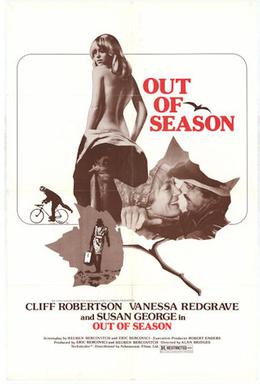
Poster via Wikipedia.
Metadata
| Title | Out of Season |
|---|---|
| Director | Alan Bridges |
| Released | 1975 |
| Wikipedia | https://en.wikipedia.org/wiki/Out_of_Season_(1975_film) |
Out of Season is a 1975 British drama film directed by Alan Bridges, and starring Vanessa Redgrave, Susan George, and Cliff Robertson. It was produced by Lorimar Productions and entered into the 25th Berlin International Film Festival.
— Wikipedia, CC BY-SA.
Story & themes
Out of Season is a chamber drama built around a confined, claustrophobic triangle. The setting is a rain-soaked English seaside resort in winter, emptied of tourists and sealed in a kind of grey stasis. Into this isolation arrives an American man, played by Cliff Robertson, who returns to reconnect with a woman, played by Vanessa Redgrave, whom he knew and loved decades earlier. The complication is her grown daughter, played by Susan George, whose presence immediately disrupts and reshapes the dynamic between the older pair.
The film's central tension turns on desire, memory, and possession. The returning American carries the weight of an unfinished past, while the mother is caught between that old attachment and the life she has built in his absence. The daughter, younger and more volatile, enters into her own charged relationship with the visitor, pulling the situation in directions that are uncomfortable and morally ambiguous.
The themes are those of time's corrosive effects on romantic idealism — what people remember versus what actually existed, and how the young and the old compete for the same emotional ground. The wintry, off-season resort serves as a deliberate metaphor: a place stripped of its usual pleasures, functioning out of its proper time.
The performances carry most of the weight. Redgrave brings a quality of suppressed longing to her role, while George's energy provides an unsettling counterpoint to the quieter, more reflective mood of the older characters.
How it ends: The triangle resolves without clean resolution or comfort. The American's return fails to recover what he imagined was waiting for him. The relationships between all three characters are damaged or fundamentally altered, and the film closes with a sense of loss rather than reconciliation — the past, it suggests, cannot be re-entered.
Direction & craft
Alan Bridges brings a restrained, chamber-drama sensibility to Out of Season, keeping the camera close to his three principals and letting the tension build through facial expressions and silences rather than plot mechanics. The film unfolds almost entirely in and around a near-empty seaside hotel in winter, and Bridges uses that off-season desolation to mirror the emotional deadlock between the characters.
The performances are the engine of the piece. Vanessa Redgrave plays the mother with a brittle, layered quality — suggesting a woman who has waited too long for the wrong thing. Susan George as her daughter holds her own against Redgrave's considerable presence, conveying resentment and vulnerability simultaneously. Cliff Robertson brings an American outsider quality to the returning man at the center of both women's lives, his restraint making him genuinely unreadable.
The cinematography leans into the bleak coastal setting — grey skies, empty promenades, the off-season hotel stripped of warmth and guests. The visual palette is deliberately cool and muted, reinforcing the sense of emotional stasis.
Bridges keeps the pacing slow and deliberate, which suits the material but demands patience from the viewer. Scenes are allowed to breathe, sometimes uncomfortably so. The editing favors long takes and holds on faces rather than cutting away to relieve pressure.
The score and sound design support this mood with minimal intrusion — the ambient sounds of wind and sea fill many of the quieter moments, emphasizing isolation.
The film's known strength is its use of confined space and off-peak atmosphere as a psychological landscape. Bridges had demonstrated similar skill with enclosed emotional dramas before, and here the technique feels purposeful — the winter resort becomes a kind of purgatory for people who cannot quite leave each other alone.
Making the film
Out of Season came together as a co-production rooted in American money and British talent. Lorimar Productions, the American television and film company that was building its feature film slate in the mid-1970s, backed the project, giving it resources unusual for a small-scale psychological drama set almost entirely in a wintry English seaside hotel.
The story — a tense triangle between a middle-aged woman, her grown daughter, and an American man from the woman's past — attracted serious stage-trained talent. Vanessa Redgrave took the role of the mother, bringing the kind of intense, interior presence the part demanded. Susan George, who had made her name in more visceral, exploitative pictures like Straw Dogs, used the film to demonstrate a quieter dramatic range as the daughter. Cliff Robertson provided the American outsider, a casting choice that also helped satisfy Lorimar's interest in a marketable transatlantic name.
Alan Bridges was a disciplined British television director who had crossed into features; he had won the Palme d'Or at Cannes in 1973 for The Hireling, which gave him credibility with prestige drama of exactly this intimate, character-driven kind.
The film was shot largely out of season — as the title implies — in a genuinely off-season English coastal setting, lending the production a natural bleakness that no studio recreation could have manufactured cheaply. The empty hotel corridors and grey winter light became as much a part of the atmosphere as the performances.
The finished film was entered into the 25th Berlin International Film Festival in 1975, signalling its positioning as serious adult cinema rather than commercial entertainment. It remains a relatively obscure title, overshadowed by the bigger careers of everyone involved.
Historical context
Out of Season arrived at a moment when British cinema was navigating serious uncertainty. American studios had retrenched after the easy-money experiments of the late 1960s, yet co-productions and transatlantic partnerships remained common — this film's backing by the American television company Lorimar Productions is a clear sign of that hybrid economy.
For Alan Bridges, the film followed his BAFTA-winning The Hireling (1973), which had announced him as a director capable of precise, psychologically taut chamber dramas. Out of Season sits naturally in that vein: a small cast, a confined setting, emotional pressure as the primary dramatic engine.
Vanessa Redgrave was at a peak of serious artistic credibility in the mid-1970s, balancing stage work, political activism, and increasingly demanding film roles. Susan George, by contrast, had built her reputation on more commercial and sometimes exploitative British productions, and a film like this represented a deliberate step toward weightier material. Cliff Robertson, the American in the cast, brought the kind of transatlantic name recognition that helped sell such projects abroad.
The film's claustrophobic off-season seaside setting also connects it to a broader cultural mood. Britain in 1975 was gripped by economic crisis, industrial unrest, and a general atmosphere of diminished confidence. Stories set in empty resorts or decaying genteel spaces — cut off from ordinary social life — carried a particular resonance in that climate. The intimate, almost theatrical triangle at the film's centre reflects the influence of European art cinema, particularly the psychological realism associated with Ingmar Bergman, whose work remained a touchstone for serious English-language drama at the time.
Its selection for the Berlin International Film Festival confirmed its positioning as prestige art-house fare rather than mainstream entertainment.
Release & reception
Out of Season arrived in 1975 as a quietly unsettling chamber piece, and its commercial performance reflected the limited appetite for brooding, intimate British drama in mainstream markets at the time. It did not make a significant splash at the box office, though its entry into the 25th Berlin International Film Festival gave it a degree of prestige and critical visibility on the European circuit that straightforward commercial release might not have provided.
Critical response tended to focus on the performances rather than the film as a whole. Vanessa Redgrave drew consistent attention for her portrayal of a woman whose past and present collide in an off-season English coastal hotel, and Susan George received notice for stepping somewhat against type in a more psychologically layered role than she had previously been associated with. Cliff Robertson, the American presence in an otherwise British production, was viewed by some reviewers as an effective catalyst for the film's tensions, though opinions on his performance were mixed.
The film was a Lorimar Productions project at a time when that American company was expanding its involvement in international co-productions, which gave Out of Season something of an transatlantic identity that sat uneasily with some critics who felt it neither fully committed to European art-house sensibilities nor satisfied mainstream tastes.
There is no record of significant controversy surrounding the film, nor did it figure prominently in major awards conversations beyond its Berlin presence. It has since settled into the category of films that are better appreciated in retrospect by those interested in 1970s British cinema or the careers of its lead performers, rather than as a work that made an immediate cultural impact on release.
Sequels, remakes & sources
Out of Season (1975) is an original screenplay by Eric Bercovici and Reuben Bercovici, not adapted from a prior novel or play, and it generated no sequels, prequels, or remakes. The film stands essentially alone in its family tree. It is a contained psychological drama about a love triangle involving a mother, her daughter, and a man from the past, with no documented stage adaptations or TV versions of the same material.
Links open a search on that service.
Influence & legacy
Out of Season occupies a quiet but genuine place in the history of 1970s British cinema. It arrived during a period when European art-house sensibilities were flowing into English-language drama, and the film sits comfortably alongside similarly chamber-piece works exploring sexual tension, memory, and class — films like The Go-Between and The Hireling, the latter also directed by Alan Bridges.
The performances by Vanessa Redgrave and Susan George, playing mother and daughter caught in competition over an American visitor, drew considerable attention at the time. Redgrave's willingness to inhabit damaged, conflicted women across this era influenced how British actresses approached complex maternal roles in the decades that followed, though Out of Season specifically is rarely cited as the primary example.
Its selection for the 25th Berlin International Film Festival gave it European visibility that purely domestic British productions of the period did not always receive, and this helped cement Bridges's reputation as a director of controlled, adult drama.
Today the film is not widely discussed in mainstream critical circles and does not appear regularly on canonical best-of lists. It is more often encountered by dedicated students of 1970s British film or admirers of Redgrave's work seeking out lesser-known entries in her filmography. Its Lorimar Productions backing — unusual for a British art drama — is occasionally noted by film historians tracing that American company's brief expansion into prestige European projects.
Its legacy is modest but real: a carefully made, atmospherically distinctive film that reflects a particular mood in mid-1970s British storytelling, and a document of three strong performers working at the height of their individual powers.