Film dossier
Get Carter
✓ Verified against Wikipedia Analysis by AI — scenes discussed, dialogue never reproduced
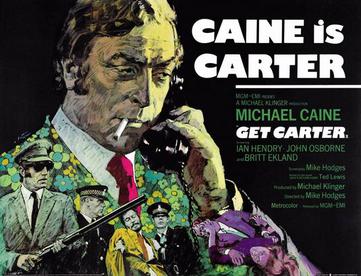
Poster via Wikipedia.
Metadata
| Title | Get Carter |
|---|---|
| Director | Mike Hodges |
| Released | 1971 |
| Wikipedia | https://en.wikipedia.org/wiki/Get_Carter |
Get Carter is a 1971 British gangster thriller film, written and directed by Mike Hodges in his directorial debut and starring Michael Caine, Ian Hendry, John Osborne, Britt Ekland and Bryan Mosley. Based on Ted Lewis's 1970 novel Jack's Return Home, the film follows Jack Carter (Caine), a London gangster who returns to his hometown in North East England after his brother's death. Suspecting foul play, and with vengeance on his mind, he investigates and interrogates, regaining a feel for the city and its hardened-criminal element.
— Wikipedia, CC BY-SA.
Story & themes
Jack Carter is a London enforcer for a crime syndicate who travels north to Newcastle after learning his brother Frank has died in circumstances officially ruled an accident. Carter is not a man inclined to accept the official version of anything. Cold, methodical, and capable of real violence, he begins asking questions around a city he recognises but no longer belongs to, pulling at threads that connect local criminals, pornography, and people who clearly wish he would leave.
The film's central tension is between Carter's professional detachment and something that functions, uncomfortably, like grief. He is not a sympathetic figure in any conventional sense — he is ruthless and sexually predatory — yet his pursuit of the truth about Frank gives the film its moral spine. Around him cluster local gangsters, their associates, and women caught in webs of exploitation, all rendered in the grey, rain-soaked textures of early 1970s Tyneside.
Thematically, Get Carter is preoccupied with the corruption that runs through ordinary British life just beneath the surface: in small-city crime, in business, in the casual abuse of power over vulnerable people. Carter's investigation does not uncover a clean enemy so much as a whole rotten system. The film refuses to glamorise him or the world he moves through, treating violence as squalid and consequence-laden rather than stylish.
How it ends: Carter exacts his revenge on those responsible for his brother's death, working his way through the guilty parties with methodical brutality. But the film refuses the satisfaction of a heroic conclusion. The violence is bleak and circular, and Carter himself does not escape the logic of the world he operates in — retribution comes for him too, swiftly and without ceremony, underlining the film's argument that this world consumes everyone in it.
Direction & craft
Mike Hodges made Get Carter as his feature directorial debut, and the confidence on screen is remarkable for a first film. He shoots Newcastle and its surrounding landscape with an almost documentary eye, letting the actual locations — the ferry crossings, the towering car parks, the grey coastal town of Horden — do the work that a studio director might have left to sets. There is no glamorisation of the environment; the industrial North East looks exactly as bleak and functional as it was.
Cinematographer Wolfgang Suschitzky gives the film a cold, naturalistic palette, favouring available light and tight compositions that trap characters in their surroundings. Some shots have an almost still-photographic quality, holding on faces a beat longer than comfortable.
Michael Caine's performance is central and exceptional. His Carter is controlled, precise, and genuinely frightening — charming enough to draw people in, violent enough to end a scene without warning. The stillness Caine brings makes the sudden eruptions of brutality more shocking. Ian Hendry matches him well as the resentful local villain Kinnear's driver, and John Osborne is icily effective in a rare acting appearance as the crime boss himself.
The editing keeps a lean, purposeful pace. Hodges wastes very little, and scenes rarely overstay their welcome. Roy Budd's score is one of the film's most distinctive elements — cool jazz piano over a sparse, modern arrangement that feels both detached and insidious. It suits the tone perfectly, underscoring Carter's methodical progress without sentimentalising anything.
The film's technique is essentially restraint: restrained camera movement, restrained score, restrained performance, all building tension through accumulation rather than spectacle. The violence, when it comes, lands hard precisely because nothing has softened it.
Making the film
Mike Hodges had been making television documentaries and dramas for ITV when producer Michael Klinger handed him Ted Lewis's novel Jack's Return Home. Hodges wrote the screenplay himself and was given the chance to direct — making Get Carter his feature debut, an unusually high-stakes beginning.
Michael Caine was cast as Jack Carter and became a driving force behind the production, not merely its lead. He was drawn to the character's cold, methodical brutality — a departure from the more charming roles he had been playing. The supporting cast was deliberately chosen to feel unglamorous and lived-in: playwright John Osborne brought an unexpected intellectual menace to the crime boss Cyril Kinnear, while Ian Hendry, once considered a bigger star than Caine, was cast as his antagonist in a detail that added genuine edge to their scenes together.
The film was shot largely on location in Newcastle upon Tyne and Gateshead in 1970. Hodges and his cinematographer Wolfgang Suschitzky embraced the industrial landscape — the grey skies, brutalist car parks, and grimy terraced streets — as a deliberate aesthetic choice rather than a limitation. The Gateshead multi-storey car park used in the film became one of British cinema's most recognisable locations before its demolition decades later.
The production maintained a lean, unsentimental approach throughout. Hodges kept the violence matter-of-fact rather than stylised, which disturbed some audiences expecting something more conventional. British critics were initially mixed in their response, though the film's reputation has grown enormously over the decades to the point where it is now widely regarded as one of the finest British films ever made.
Historical context
Get Carter arrived at a hinge moment in British cinema. The late 1960s kitchen-sink realism of directors like Karel Reisz and Lindsay Anderson had run its commercial course, and the genteel spy glamour of early Bond was looking increasingly artificial. Hodges, who had come up through television documentary and drama, stepped into this gap with his debut feature and immediately wrong-footed both traditions.
For Michael Caine, the film came after a decade of establishing himself through The Ipcress File, Alfie, and The Italian Job. Those roles had made him a star but often kept him charming and watchable even in moral ambiguity. Carter stripped that away. Caine was given a character of almost unrelenting coldness, and he embraced it without vanity.
The early 1970s in Britain carried a particular sourness — industrial unrest, rising crime statistics, disillusionment after the optimism of the previous decade. Newcastle, where the film was shot on location, was visibly decaying around its edges: concrete developments, working men's clubs, and a pornography trade moving in alongside legitimate business. Hodges used all of this rather than hiding it, giving the film a texture that felt closer to reportage than to studio crime pictures.
Culturally, Get Carter was part of a harder international wave. American cinema had just produced Bonnie and Clyde and Dirty Harry; the heroic gangster was being replaced by the morally contaminated one. Hodges and Caine absorbed that shift and produced a British equivalent that was arguably bleaker than its American counterparts, stripping out redemption almost entirely.
The supporting cast reinforced the realism. John Osborne, the playwright who had helped define Angry Young Man theatre in the 1950s, brought an incongruous literary weight to his role as a criminal boss, a piece of casting that felt deliberately provocative.
Release & reception
Get Carter opened in Britain in March 1971 to a mixed critical reception that would look very different in hindsight. Several reviewers at the time found the film too cold and brutal, uncomfortable with its relentless grimness and the moral vacuum at its centre. American critics were similarly unsure, and the film performed modestly rather than spectacularly at the box office on its initial release, without making a significant commercial splash on either side of the Atlantic.
What critics tended to agree on, even those who disliked the film, was Michael Caine's performance — lean, controlled, and stripped of the charm he had deployed in earlier roles. The Newcastle and Gateshead locations also drew notice, giving the film an authentically grim industrial texture that set it apart from glossier contemporaries.
The film attracted some controversy for its violence and sexual content, which were notably unsparing for a mainstream British production. It carried an X certificate in the UK, limiting its audience.
Its reputation grew steadily over the following decades. Critics and filmmakers came to regard it as one of the defining British crime films, admired for its refusal to sentimentalise either its protagonist or his world. By the 1990s and into the 2000s it was routinely appearing on best-of-British lists and influencing a new generation of crime directors.
A Hollywood remake in 2000 starring Sylvester Stallone arrived to poor reviews, which had the useful effect of reinforcing how precisely the original belonged to its specific time and place. The 1971 film is now widely considered not just a genre landmark but a significant piece of British social cinema.
Sequels, remakes & sources
Get Carter (1971) is adapted from Ted Lewis's novel and stands as one of British cinema's most influential crime films. It spawned a direct American remake in 2000, and Ted Lewis later wrote a follow-up novel. The original film's impact also attracted documentary examination. Beyond these, Get Carter stands largely alone — no official prequel, TV series, or stage adaptation has entered the well-documented canon, making its family tree compact but significant.
Links open a search on that service.
Influence & legacy
Get Carter arrived largely unheralded but grew steadily in reputation until it was widely regarded as one of the finest British crime films ever made. Its influence on later filmmakers was considerable. Directors including Guy Ritchie and Matthew Vaughn have acknowledged the film's DNA in their own work, and its unromantic, methodical portrait of English criminal life — unglamorous northern locations, casual brutality, moral emptiness — provided a template that British crime cinema kept returning to across subsequent decades.
The image of Michael Caine standing in a doorway holding a shotgun became one of the defining images of 1970s British film culture. The film's willingness to make its protagonist genuinely ruthless rather than charming marked a break from the more theatrical villainy of earlier British thrillers.
Several canonical rankings have confirmed its standing:
- The British Film Institute has placed it among the greatest British films of all time
- Empire and similar publications have repeatedly ranked it among the best British films ever made
- Critics frequently cite it alongside Performance and Villain as evidence that early 1970s British cinema produced a remarkably dark and serious strand of crime filmmaking
A 2000 Hollywood remake starring Sylvester Stallone was poorly received, which had the effect of reinforcing the original's reputation by contrast.
The Newcastle locations — the Tyne bridges, the coke works, the grey terraced streets — became pilgrimage sites for admirers of the film, and the city has embraced it as a piece of local cultural heritage. Today Get Carter is treated not merely as a genre piece but as a social document, capturing a particular texture of English working-class life at a specific historical moment with an accuracy that feels almost accidental.