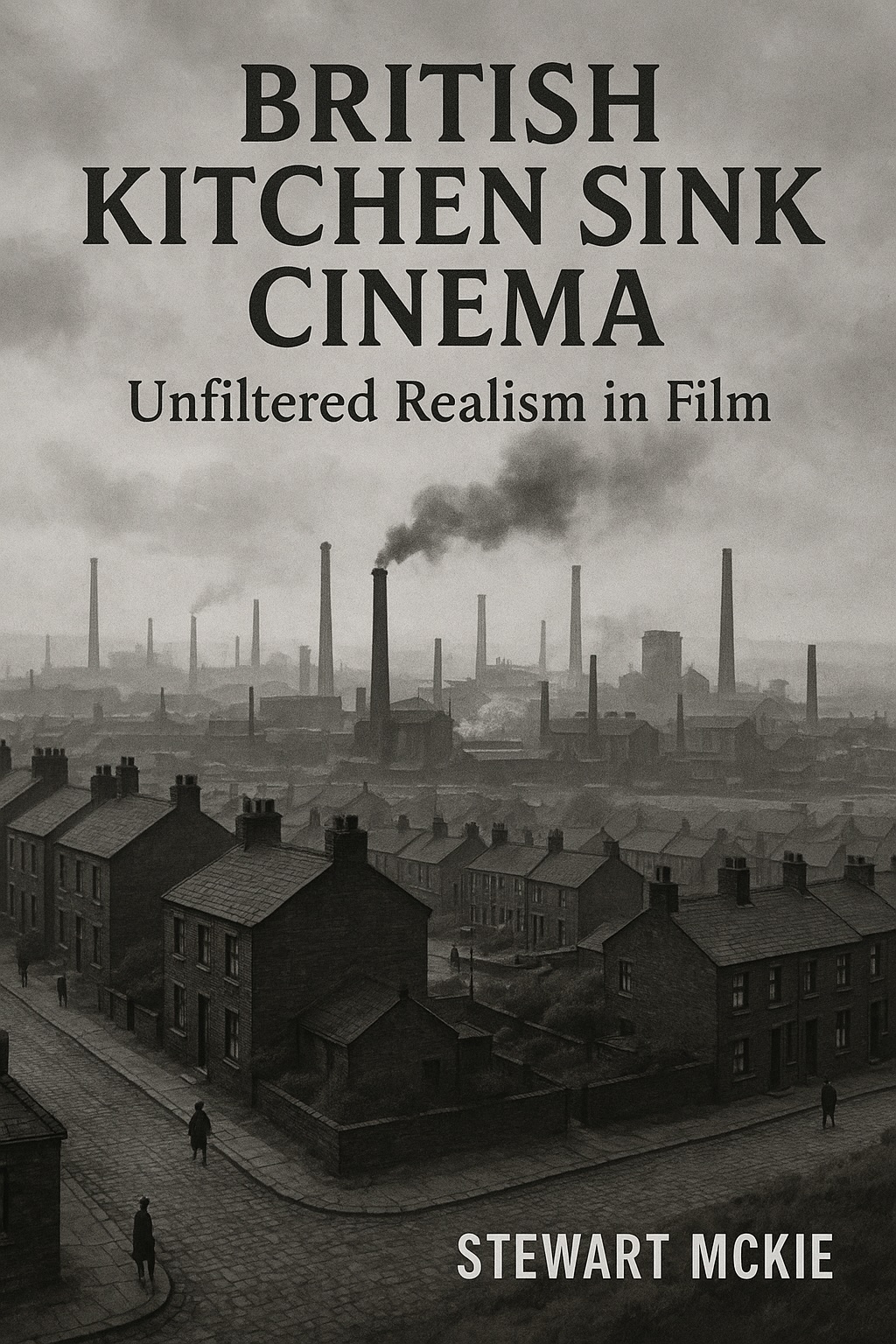
Kitchen Sink Cinema
The world of London, 1966
The Affluent Worker and the Earnings Gap, 1959–1963 unverified
Average weekly earnings for male manual workers rose from around £10 in 1955 to nearly £16 by 1965, a real-terms increase that fuelled talk of working-class affluence but left the earnings gap with non-manual workers essentially unchanged at roughly 30–40 per cent. The Affluent Worker studies by Goldthorpe and Lockwood at Vauxhall in Luton found that higher wages did not dissolve class identity or produce middle-class values, directly contesting the 'embourgeoisement' thesis. Kitchen sink films used consumer goods — the new television, the motorbike — as props for this ambiguous prosperity.
AI-sourced — verify against ONS/Hansard/period sources before publishing.
Peter Rachman

Perec "Peter" Rachman was a Polish-born landlord who operated in Notting Hill, London in the 1950s and early 1960s. He became notorious for his exploitation of his tenants, with the word "Rachmanism" entering the Oxford English Dictionary as a synonym for the exploitation and intimidation of tenants.
Peter Rachman, a London landlord, was posthumously revealed in 1963 during the Profumo Affair to have used intimidation, threats, and physical violence to evict protected tenants in Notting Hill and replace them with Caribbean immigrants charged extortionate rents — exploiting both the 1957 decontrol and racist housing discrimination. The scandal entered the language as 'Rachmanism' and led directly to the Milner Holland Committee on London housing. It made viscerally public the connection between class, race, housing precarity, and landlord power that kitchen sink cinema explored.
Education Act 1944

The Education Act 1944 is an act of the Parliament of the United Kingdom which made major changes in the provision and governance of secondary schools in England and Wales. It is also known as the Butler Act after the President of the Board of Education, R. A. Butler. Historians consider it a "triumph for progressive reform," and it became a core element of the post-war consensus supported by all major parties. The Act was repealed in steps with the last parts repealed in 1996.
The 1944 Act created a tripartite secondary system of grammar, technical, and secondary modern schools, with free places allocated by the Eleven Plus examination. In theory it opened grammar schools to working-class children on merit; in practice the system overwhelmingly reproduced middle-class advantage, a central grievance dramatised across kitchen sink films. The Act remained the statutory framework for state education throughout the kitchen sink period, and its meritocratic promise versus lived reality drove narratives of frustrated aspiration.
Robbins Report
The Robbins Report was commissioned by the British government and published in 1963. The committee met from 1961 to 1963. After the report's publication, its conclusions were accepted by the government on 24 October 1963.
The Robbins Committee reported that higher education should be available to all who were qualified by ability and attainment, recommending an immediate expansion from roughly 216,000 to 560,000 university places by 1980. The report legitimised the idea that working-class students had a right to university, directly underpinning the creation of new plate-glass universities and the expansion of existing ones. Its publication coincided with the peak years of kitchen sink cinema and gave statistical authority to the theme of education as an escape route from class origin.
CITB

The Construction Industry Training Board (CITB), a quasi-autonomous near-government organisation (quango), is one of two construction industry training board for the UK construction industry.
The Industrial Training Act 1964 created statutory Industrial Training Boards empowered to levy firms and fund apprenticeships and vocational training, acknowledging that the existing apprenticeship system was failing to equip the working class with transferable skills or routes to advancement. Before the Act, training was almost entirely controlled by trade unions and employers through informal agreements, leaving many workers locked into single trades with no formal certification. The Act signalled a state recognition that class-bound occupational inheritance was a structural economic problem as well as a social injustice.
Housing Act 1957

The Housing Act 1957 was an act of the Parliament of the United Kingdom that consolidated enactments relating to housing in England and Wales.
The Housing Act 1957 decontrolled rents on higher-value properties and allowed landlords to charge market rents on re-letting, ending the protection that had kept many working-class and lower-middle-class tenants in affordable accommodation since the 1940s. The Act triggered a wave of evictions and Rachmanism — the use of harassment and intimidation to clear rent-controlled tenants — most notoriously exposed in the Rachman scandal of 1963. The legislation made the private rented room, the bedsit, and the slum landlord central locations and antagonists in kitchen sink films.
The Bullock and Crowther Reports on Secondary Modern Schools unverified
The Crowther Report of 1959 documented that the majority of working-class children left school at fifteen with no formal qualifications, entering manual or routine clerical work and largely foreclosed from professional careers. It found that two-thirds of National Service recruits had left school at the minimum age and that early leaving was strongly correlated with unskilled fathers. The report made official what kitchen sink directors showed on screen: the school-leaving moment as a class sorting mechanism rather than a meritocratic threshold.
AI-sourced — verify against ONS/Hansard/period sources before publishing.
Rise of the Grammar School 'Scholarship Boy' and Youth Consumer Culture unverified
Between 1955 and 1965 teenage spending power roughly doubled in real terms, with working-class youth the primary market for records, coffee bars, and ready-to-wear fashion — a shift documented by Mark Abrams in The Teenage Consumer (1959). Abrams estimated British teenagers were spending around £900 million a year by 1959, mostly on non-essential goods, creating a visible culture of working-class enjoyment that sat uneasily with older notions of deference and 'knowing your place'. Kitchen sink films repeatedly stage the tension between this new consumer freedom and the continuing structural constraints of class.
AI-sourced — verify against ONS/Hansard/period sources before publishing.
Grammar School Attendance by Class, early 1960s unverified
Studies conducted for the Robbins Report found that a child from a professional or managerial family was roughly five times more likely to reach full-time higher education than a child from a semi-skilled or unskilled working-class family. Only about 4 per cent of the university student population in 1961 came from unskilled manual backgrounds, against roughly 30 per cent of the general population. These figures gave concrete weight to the 'scholarship boy' narratives central to films such as Room at the Top and Saturday Night and Sunday Morning.
AI-sourced — verify against ONS/Hansard/period sources before publishing.
Occupational Class Structure and Intergenerational Mobility, 1949 and 1963 unverified
David Glass's 1949 LSE mobility study, and its updating in the early 1960s, found that intergenerational occupational mobility in Britain was lower than in the United States, with the professional and managerial classes largely self-recruiting. Roughly 60 per cent of sons of professional fathers entered professional or managerial work, while fewer than 10 per cent of sons of unskilled fathers did so. These numbers underpinned the period's preoccupation with the 'lucky few' who escaped through education, a trajectory that is the explicit plot of Room at the Top and A Kind of Loving.
AI-sourced — verify against ONS/Hansard/period sources before publishing.