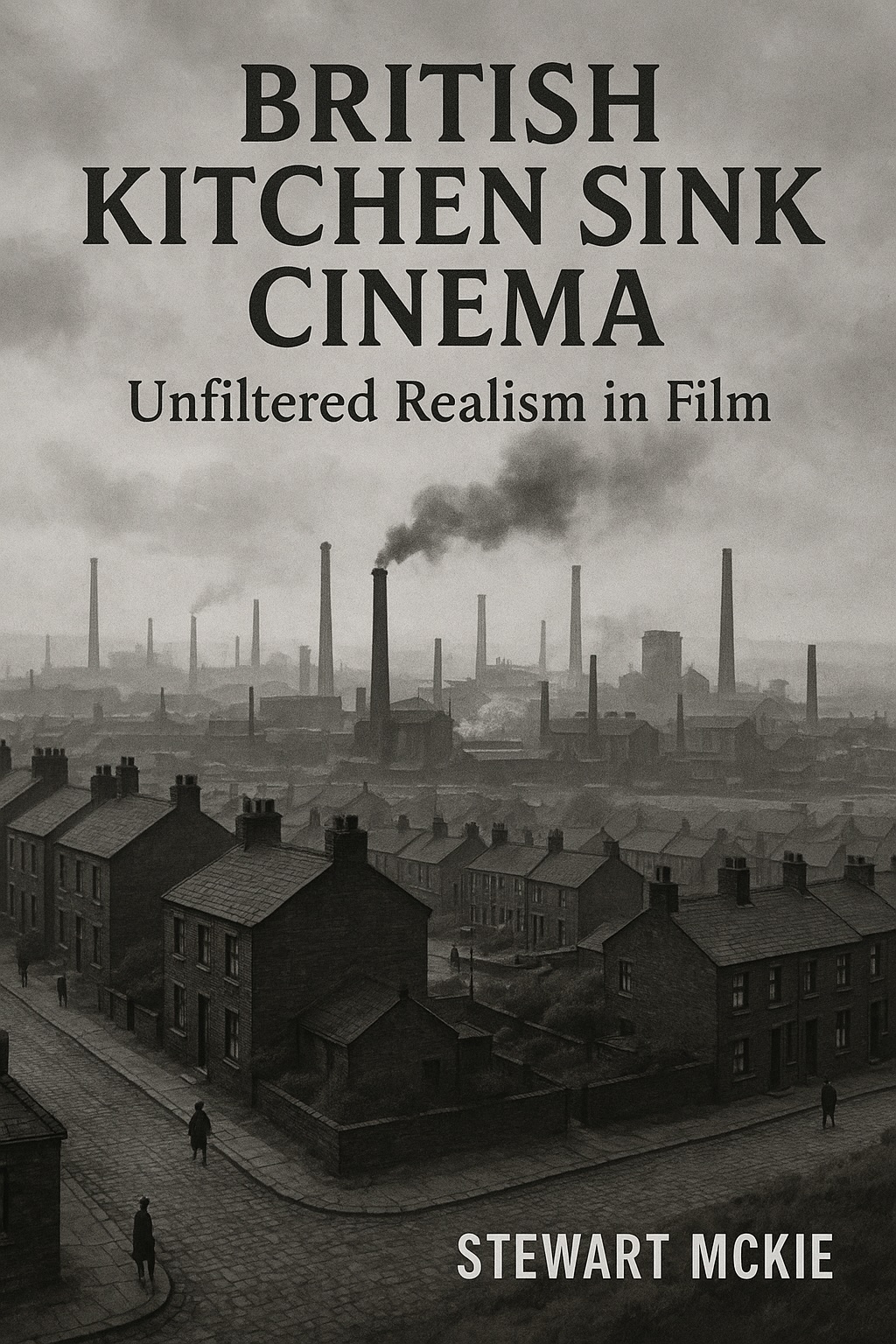
Kitchen Sink Cinema
The world of London, 1959
Average manual wage, Britain 1959 unverified
The average weekly wage for a male manual worker in Britain in 1959 was approximately £11 to £12, with skilled trades such as engineering fetching slightly more. Unskilled labourers in London might earn around £8–£9 per week. A junior office clerk could expect perhaps £7–£8 weekly, making the gap between collar colours a constant source of resentment.
AI-sourced — verify against ONS/Hansard/period sources before publishing.
The Affluent Worker and the Earnings Gap, 1959–1963 unverified
Average weekly earnings for male manual workers rose from around £10 in 1955 to nearly £16 by 1965, a real-terms increase that fuelled talk of working-class affluence but left the earnings gap with non-manual workers essentially unchanged at roughly 30–40 per cent. The Affluent Worker studies by Goldthorpe and Lockwood at Vauxhall in Luton found that higher wages did not dissolve class identity or produce middle-class values, directly contesting the 'embourgeoisement' thesis. Kitchen sink films used consumer goods — the new television, the motorbike — as props for this ambiguous prosperity.
AI-sourced — verify against ONS/Hansard/period sources before publishing.
Everyday prices, London 1959 unverified
A pint of bitter in a London pub cost around 1s 3d (about 6p in decimal money). A loaf of bread was roughly 5d, a packet of ten cigarettes (such as Players No. 6) about 2s 4d, and a single bus fare within the London Transport central zone started at 2d. A seat in the stalls at a West End cinema cost around 3s 6d.
AI-sourced — verify against ONS/Hansard/period sources before publishing.
Living Doll (Cliff Richard song) unverified
Cliff Richard's 'Living Doll', released in July 1959, reached number one in the UK Singles Chart and stayed there for six weeks, becoming one of the biggest British hits of the year. It marked a deliberate softening of Richard's image from rock-and-roller to mainstream pop star. The record sold well over 250,000 copies in Britain alone.
AI-sourced — verify against ONS/Hansard/period sources before publishing.
Emergency Ward 10
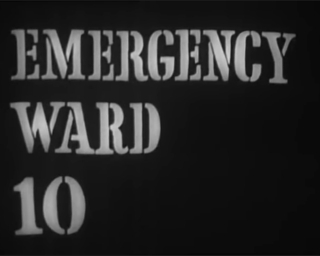
Emergency Ward 10 is a British medical soap opera series shown on ITV between 1957 and 1967. It is considered to be one of British television's first major soap operas.
Emergency Ward 10, ITV's twice-weekly hospital drama, was one of the most-watched programmes on British television in 1959, routinely drawing audiences of 15 million or more. It had launched in February 1957 and was set in the fictional Oxbridge General Hospital. The show was significant for featuring one of British television's first interracial romances, broadcast in 1964, but by 1959 it was already a cultural fixture.
Obscene Publications Act 1959

The Obscene Publications Act 1959 is an Act of Parliament of the United Kingdom Parliament, which significantly reformed the law related to obscenity in England and Wales. Before the passage of the Act, the law on publishing obscene materials was governed by the common-law case of R v Hicklin, which had no exceptions for artistic merit or the public good. During the 1950s, the Society of Authors formed a committee to recommend reform of the existing law, submitting a draft bill to the Home Office in February 1955. After several failed attempts to push a bill through Parliament, a committee wrote a viable bill, which was introduced to Parliament by Roy Jenkins and given royal assent on 29 July 1959, coming into force on 29 August 1959 as the Obscene Publications Act 1959. With the committee consisting of both censors and reformers, the actual reform of the law was limited, with several extensions of police powers included in the final version.
The Obscene Publications Act 1959 received Royal Assent on 29 July 1959 and transformed British censorship law by introducing a 'public good' defence allowing literary merit to be weighed against obscenity. It directly enabled the landmark Regina v Penguin Books Ltd trial the following year over Lady Chatterley's Lover. The Act was the result of years of campaigning by the Society of Authors and reflected growing pressure to distinguish serious literature from pornography.
Peter Rachman
Perec "Peter" Rachman was a Polish-born landlord who operated in Notting Hill, London in the 1950s and early 1960s. He became notorious for his exploitation of his tenants, with the word "Rachmanism" entering the Oxford English Dictionary as a synonym for the exploitation and intimidation of tenants.
Peter Rachman, a London landlord, was posthumously revealed in 1963 during the Profumo Affair to have used intimidation, threats, and physical violence to evict protected tenants in Notting Hill and replace them with Caribbean immigrants charged extortionate rents — exploiting both the 1957 decontrol and racist housing discrimination. The scandal entered the language as 'Rachmanism' and led directly to the Milner Holland Committee on London housing. It made viscerally public the connection between class, race, housing precarity, and landlord power that kitchen sink cinema explored.
Education Act 1944

The Education Act 1944 is an act of the Parliament of the United Kingdom which made major changes in the provision and governance of secondary schools in England and Wales. It is also known as the Butler Act after the President of the Board of Education, R. A. Butler. Historians consider it a "triumph for progressive reform," and it became a core element of the post-war consensus supported by all major parties. The Act was repealed in steps with the last parts repealed in 1996.
The 1944 Act created a tripartite secondary system of grammar, technical, and secondary modern schools, with free places allocated by the Eleven Plus examination. In theory it opened grammar schools to working-class children on merit; in practice the system overwhelmingly reproduced middle-class advantage, a central grievance dramatised across kitchen sink films. The Act remained the statutory framework for state education throughout the kitchen sink period, and its meritocratic promise versus lived reality drove narratives of frustrated aspiration.
Robbins Report
The Robbins Report was commissioned by the British government and published in 1963. The committee met from 1961 to 1963. After the report's publication, its conclusions were accepted by the government on 24 October 1963.
The Robbins Committee reported that higher education should be available to all who were qualified by ability and attainment, recommending an immediate expansion from roughly 216,000 to 560,000 university places by 1980. The report legitimised the idea that working-class students had a right to university, directly underpinning the creation of new plate-glass universities and the expansion of existing ones. Its publication coincided with the peak years of kitchen sink cinema and gave statistical authority to the theme of education as an escape route from class origin.
CITB

The Construction Industry Training Board (CITB), a quasi-autonomous near-government organisation (quango), is one of two construction industry training board for the UK construction industry.
The Industrial Training Act 1964 created statutory Industrial Training Boards empowered to levy firms and fund apprenticeships and vocational training, acknowledging that the existing apprenticeship system was failing to equip the working class with transferable skills or routes to advancement. Before the Act, training was almost entirely controlled by trade unions and employers through informal agreements, leaving many workers locked into single trades with no formal certification. The Act signalled a state recognition that class-bound occupational inheritance was a structural economic problem as well as a social injustice.
Housing Act 1957

The Housing Act 1957 was an act of the Parliament of the United Kingdom that consolidated enactments relating to housing in England and Wales.
The Housing Act 1957 decontrolled rents on higher-value properties and allowed landlords to charge market rents on re-letting, ending the protection that had kept many working-class and lower-middle-class tenants in affordable accommodation since the 1940s. The Act triggered a wave of evictions and Rachmanism — the use of harassment and intimidation to clear rent-controlled tenants — most notoriously exposed in the Rachman scandal of 1963. The legislation made the private rented room, the bedsit, and the slum landlord central locations and antagonists in kitchen sink films.
Peter Rachman
Perec "Peter" Rachman was a Polish-born landlord who operated in Notting Hill, London in the 1950s and early 1960s. He became notorious for his exploitation of his tenants, with the word "Rachmanism" entering the Oxford English Dictionary as a synonym for the exploitation and intimidation of tenants.
In 1959 Peter Rachman was at the height of his activities as a private landlord in Notting Hill and Paddington, exploiting the absence of rent controls on unfurnished lettings to charge West Indian and other migrant tenants exorbitant rents for grossly overcrowded rooms. The Rent Act 1957 had decontrolled higher-value properties, fuelling sharp rent increases across inner London. A single furnished room in Notting Hill could cost a tenant £2 to £3 per week — a quarter or more of a manual worker's wage.
The Bullock and Crowther Reports on Secondary Modern Schools unverified
The Crowther Report of 1959 documented that the majority of working-class children left school at fifteen with no formal qualifications, entering manual or routine clerical work and largely foreclosed from professional careers. It found that two-thirds of National Service recruits had left school at the minimum age and that early leaving was strongly correlated with unskilled fathers. The report made official what kitchen sink directors showed on screen: the school-leaving moment as a class sorting mechanism rather than a meritocratic threshold.
AI-sourced — verify against ONS/Hansard/period sources before publishing.
Food rationing's aftermath and the new supermarket unverified
Rationing had ended entirely in Britain only in July 1954, and by 1959 processed and convenience foods were booming: tins of Heinz baked beans, instant mashed potato (Smash would come later, but Yeoman potato powder was available), and sliced white bread from the Chorleywood process were staples. The first British self-service supermarkets were expanding rapidly; the Express Dairy opened a large self-service store in London in the late 1950s. Meat consumption was rising fast as real wages improved, with the average Briton eating about 2 lb of meat per week by 1959.
AI-sourced — verify against ONS/Hansard/period sources before publishing.
Teddy Boys
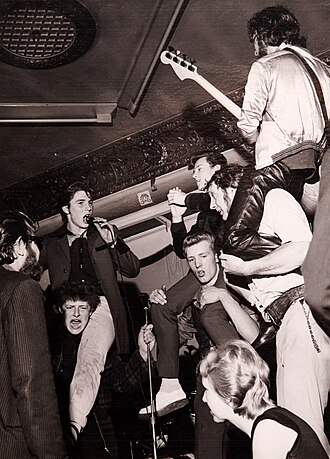
The Teddy Boys or Teds were a mainly British youth subculture originating in the early 1950s to mid-1960s and then revived in the 1970s who were interested in rock and roll and R&B music, wearing clothes partly inspired by the styles worn by dandies in the Edwardian period, which Savile Row tailors had attempted to reintroduce in Britain after the Second World War.
Teddy Boys, though at their peak in the mid-1950s, remained a vivid street presence in working-class London districts such as Elephant and Castle and Bethnal Green in 1959. Their uniform — drape jacket, drainpipe trousers, crepe-soled 'brothel creeper' shoes and elaborate quiff — was a self-conscious rejection of utility austerity. Outfitting a full Teddy Boy suit from a tailor in the Cut, Lambeth, could cost upward of £15, well over a week's wages.
Rise of the Grammar School 'Scholarship Boy' and Youth Consumer Culture unverified
Between 1955 and 1965 teenage spending power roughly doubled in real terms, with working-class youth the primary market for records, coffee bars, and ready-to-wear fashion — a shift documented by Mark Abrams in The Teenage Consumer (1959). Abrams estimated British teenagers were spending around £900 million a year by 1959, mostly on non-essential goods, creating a visible culture of working-class enjoyment that sat uneasily with older notions of deference and 'knowing your place'. Kitchen sink films repeatedly stage the tension between this new consumer freedom and the continuing structural constraints of class.
AI-sourced — verify against ONS/Hansard/period sources before publishing.
Betting and Gaming Act 1960

The Betting and Gaming Act 1960 was a British act of Parliament that legalised additional forms of gambling in the United Kingdom. It was passed on 1 September 1960 and came into effect on 1 January 1961.
In 1959 street betting was still technically illegal in England under the Street Betting Act 1906, yet it was openly practised through networks of street bookmakers' runners across working-class London. Parliament was actively debating what would become the Betting and Gaming Act 1960, which legalised off-course cash betting and led to the rapid opening of licensed betting shops from 1961 onward. In the meantime, the Saturday football pools — with Littlewoods and Vernons competing for coupons — drew participation from millions of households.
Grammar School Attendance by Class, early 1960s unverified
Studies conducted for the Robbins Report found that a child from a professional or managerial family was roughly five times more likely to reach full-time higher education than a child from a semi-skilled or unskilled working-class family. Only about 4 per cent of the university student population in 1961 came from unskilled manual backgrounds, against roughly 30 per cent of the general population. These figures gave concrete weight to the 'scholarship boy' narratives central to films such as Room at the Top and Saturday Night and Sunday Morning.
AI-sourced — verify against ONS/Hansard/period sources before publishing.
Occupational Class Structure and Intergenerational Mobility, 1949 and 1963 unverified
David Glass's 1949 LSE mobility study, and its updating in the early 1960s, found that intergenerational occupational mobility in Britain was lower than in the United States, with the professional and managerial classes largely self-recruiting. Roughly 60 per cent of sons of professional fathers entered professional or managerial work, while fewer than 10 per cent of sons of unskilled fathers did so. These numbers underpinned the period's preoccupation with the 'lucky few' who escaped through education, a trajectory that is the explicit plot of Room at the Top and A Kind of Loving.
AI-sourced — verify against ONS/Hansard/period sources before publishing.
London Underground

The London Underground is a rapid transit system serving Greater London and some parts of the adjacent home counties of Buckinghamshire, Essex, and Hertfordshire in England. It is part of the network of transport services managed by Transport for London.
Greater London's population stood at approximately 8.2 million in 1959, its post-war peak before suburban dispersal accelerated. London Transport's Underground network carried around 674 million passenger journeys in the financial year 1958–59. The Victoria line had not yet been built; Parliament gave approval for it in August 1962, meaning Londoners in 1959 still depended entirely on the pre-war tube map.