Kitchen Sink Cinema
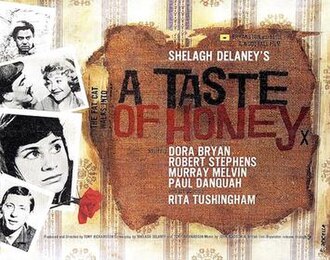
The world of Salford, 1961
Manual wages in Salford, 1961 unverified
The average weekly wage for a male manual worker in Britain in 1961 was approximately £14 10s. In Salford's textile and engineering trades, women could expect closer to £6–£7 a week. Unemployment in the Salford area ran at under 2%, as dockland and factory work still absorbed most school-leavers at 15.
AI-sourced — verify against ONS/Hansard/period sources before publishing.
Everyday prices in Salford, 1961 unverified
A pint of bitter in a Salford pub cost around 1s 2d (about 6p). A loaf of bread was roughly 10d, and a packet of ten Player's cigarettes cost 2s 4d. Weekly rent for a back-to-back terraced house in the Ordsall or Regent Road area ran to about 12–15 shillings, paid to the council or a private landlord.
AI-sourced — verify against ONS/Hansard/period sources before publishing.
Runaway (Del Shannon song)
"Runaway" is a 1961 number-one Billboard Hot 100 song by Del Shannon. It was written by Shannon and keyboardist Max Crook, and became a major international hit. It topped the Billboard charts for four consecutive weeks, and Billboard ranked it as the No. 5 song for 1961. It was No. 472 on the 2010 version of Rolling Stone's list of the 500 Greatest Songs of All Time and No. 466 on the 2004 version.
Del Shannon's 'Runaway' reached number 1 in the UK charts in May 1961 and stayed there for three weeks. On Salford's dance floors — in venues like the Ritz Ballroom just across the river in Manchester — it was one of the defining sounds of that summer. Its distinctive Musitron solo made it immediately recognisable on the newly ubiquitous transistor radio.
Coronation Street

Coronation Street is a British television soap opera created by Granada Television and shown on ITV since 9 December 1960. The programme centres on a cobbled, terraced street in the fictional town of Weatherfield in Greater Manchester. The location was itself based on Salford, the hometown of the show's first screenwriter and creator, Tony Warren.
Coronation Street launched on ITV on 9 December 1960 and by 1961 was drawing audiences of over 13 million. Set in a fictionalised Salford-Manchester terrace, it was filmed at Granada Television's studios on Quay Street, less than a mile from the streets A Taste of Honey depicts. Salford viewers recognised the corner shop, the cobbles and the accent as emphatically their own.
Suicide Act 1961

The Suicide Act 1961 is an act of the Parliament of the United Kingdom. It decriminalised the act of suicide in England and Wales so that those who survived a suicide attempt would no longer be prosecuted.
The Suicide Act received royal assent on 3 August 1961, decriminalising suicide and attempted suicide in England and Wales for the first time. Before this date, a survivor of a suicide attempt could be prosecuted; families of those who died could face coroner inquiries with criminal implications. The Act reflected a broader shift in public attitudes to mental health and personal desperation that ran alongside the social realism of films like A Taste of Honey.
Salford
Salford is a city in Greater Manchester, England, on the western bank of the River Irwell which forms its boundary with Manchester city centre. Landmarks include the former town hall, Salford Cathedral, Salford Lads' Club and St Philip's Church. In 2021 it had a population of 129,794. The demonym for people from Salford is Salfordian.
Salford Corporation was in the middle of a major slum-clearance programme by 1961, demolishing the worst of the Victorian back-to-backs in Ordsall, Greengate and Hanky Park. Residents were moved to new council estates such as Pendleton and Worsley Mesnes. Over 9,000 houses were declared unfit for human habitation in Salford during the 1950s survey, driving the clearances that re-shaped the borough through the 1960s.
Salford Quays
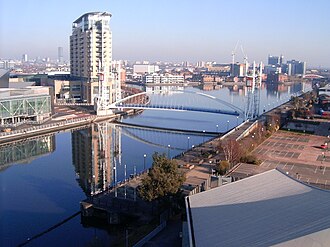
Salford Quays is an area of Salford, Greater Manchester, England, near the end of the Manchester Ship Canal. Previously the site of Manchester Docks, it faces Trafford across the canal.
Salford Docks, the inland terminus of the Manchester Ship Canal opened in 1894, still employed several thousand dockers and warehousemen in 1961, handling around 16 million tonnes of cargo a year through the canal. Casual daily hiring on the dockside was common, with men gathering each morning at the dock gates hoping to be picked. The docks were one of the few employers offering relatively high wages to unskilled men — up to £18 a week with overtime.
Fish and chips

Fish and chips is a hot dish consisting of battered and fried fish, served with chips. Often considered the national dish of the United Kingdom, fish and chips originated in England in the 19th century. Today, the dish is a common takeaway food in numerous other countries, particularly English-speaking and Commonwealth nations.
Fish and chip shops were a cornerstone of working-class eating in Salford; a portion of chips cost around 4d and a piece of cod 8d in 1961. Most families ate chips at least twice a week, often wrapped in newspaper. Mushy peas, scraps and pickled onions were standard accompaniments in Lancashire chip shops, distinguishing them from southern equivalents.
Mod (subculture)
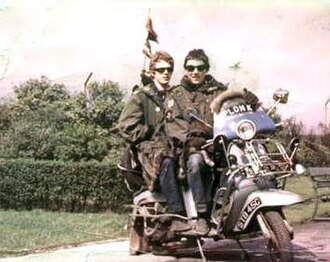
Mod, from the word modernist, is a subculture that began in the late 1950s London and spread throughout Great Britain, eventually influencing fashions and trends in other countries. It continues today on a smaller scale. Focused on music and fashion, the subculture has its roots in a small group of stylish London-based young men and women in the late 1950s who were termed modernists because they listened to modern jazz.
By 1961 the Mod look was spreading outward from London to northern cities including Manchester and Salford, carried by Italian-cut suits, narrow lapels and winkle-picker shoes for young men. Young women were wearing shift dresses, stiletto heels and beehive hairstyles popularised by singers such as Helen Shapiro. Ready-to-wear chain stores like Burton and C&A on Market Street provided affordable versions of these looks on a factory wage.
Illegitimacy rate in England and Wales, 1961 unverified
In 1961 approximately 5.8% of live births in England and Wales were registered as illegitimate — around 48,000 children. Social stigma attached strongly to unmarried mothers, who were routinely pressured into adoption or hasty marriage. Salford, with its high density of young working-class women in factory and domestic work, reflected these national patterns; welfare support was minimal and the National Assistance Board means-tested any claim rigorously.
AI-sourced — verify against ONS/Hansard/period sources before publishing.
From the page
A Taste of Honey
The people
What it dramatises
Housing — slums, clearance, prefabs, new estates, the high-rise promise
Women, marriage, abortion and unwanted pregnancy
The North vs London
Race and immigration
Homosexuality before decriminalisation
Sex - infidelity, before marriage, dating
About the film
A Taste of Honey is a 1961 British New Wave drama film directed by Tony Richardson and starring Rita Tushingham, Dora Bryan, Robert Stephens and Murray Melvin. It is an adaptation of the 1958 play of the same name by Shelagh Delaney. Delaney wrote the screenplay with Richardson, who had directed the original Broadway production of the play in 1960. As with the play, the film is an exemplar of a social realist genre of British cultural movement known as kitchen sink realism.