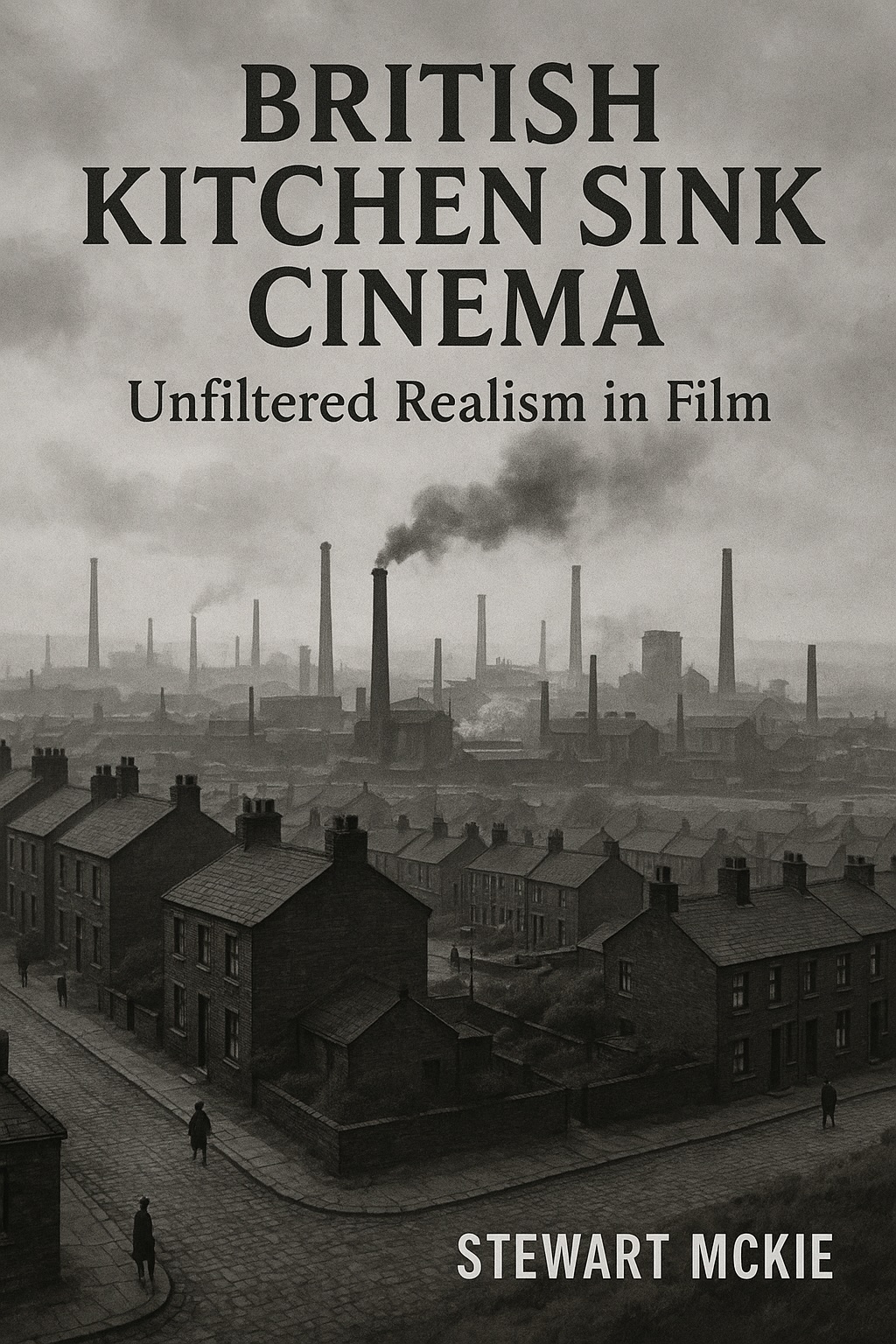
Kitchen Sink Cinema
The world of Oldham, 1966
Manual wages in Oldham's textile mills, 1966 unverified
A male cotton-weaving operative in Oldham earned roughly £14–£16 per week in 1966, while women doing similar work took home closer to £9–£11. The national average weekly wage for male manual workers stood at approximately £20 by mid-decade. Oldham's reliance on the declining cotton trade meant local wages lagged behind newer industrial centres like Coventry or Slough.
AI-sourced — verify against ONS/Hansard/period sources before publishing.
The Affluent Worker and the Earnings Gap, 1959–1963 unverified
Average weekly earnings for male manual workers rose from around £10 in 1955 to nearly £16 by 1965, a real-terms increase that fuelled talk of working-class affluence but left the earnings gap with non-manual workers essentially unchanged at roughly 30–40 per cent. The Affluent Worker studies by Goldthorpe and Lockwood at Vauxhall in Luton found that higher wages did not dissolve class identity or produce middle-class values, directly contesting the 'embourgeoisement' thesis. Kitchen sink films used consumer goods — the new television, the motorbike — as props for this ambiguous prosperity.
AI-sourced — verify against ONS/Hansard/period sources before publishing.
These Boots Are Made for Walkin'
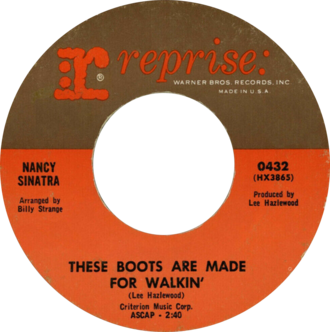
"These Boots Are Made for Walkin'" is a hit song written by Lee Hazlewood and recorded by American singer Nancy Sinatra. It charted on January 22, 1966, and reached No. 1 in the United States Billboard Hot 100 and in the UK Singles Chart.
Nancy Sinatra's 'These Boots Are Made for Walkin'' reached number one on the UK Singles Chart in February 1966 and dominated jukeboxes and Radio Caroline throughout the early part of the year. The pirate station Radio Caroline North, broadcasting from the Irish Sea, was the favoured music source for young people across the Lancashire towns before the Marine Broadcasting Offences Act closed it in 1967. Local Oldham dance halls such as the Astoria regularly hosted travelling beat groups to capitalise on the chart-driven craze.
Coronation Street

Coronation Street is a British television soap opera created by Granada Television and shown on ITV since 9 December 1960. The programme centres on a cobbled, terraced street in the fictional town of Weatherfield in Greater Manchester. The location was itself based on Salford, the hometown of the show's first screenwriter and creator, Tony Warren.
Coronation Street, set in the fictional Weatherfield — closely modelled on Salford but recognisable to every Oldham viewer — was pulling audiences of 18–20 million per episode by 1966. The programme aired twice weekly on ITV and depicted the kind of terraced-street community that Oldham's own slum-clearance programme was simultaneously demolishing. Characters such as Ena Sharples and Elsie Tanner were household names across the cotton towns.
Aberfan disaster
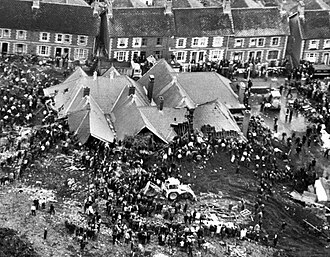
The Aberfan disaster was the catastrophic collapse of a colliery spoil tip on 21 October 1966. The tip had been created on a mountain slope above the Welsh village of Aberfan, near Merthyr Tydfil, and overlaid a natural spring. Heavy rain led to a build-up of water within the tip which caused it to suddenly slide downhill as a slurry, killing 116 children and 28 adults as it engulfed Pantglas Junior School and a row of houses. The tip was the responsibility of the National Coal Board (NCB), and the subsequent inquiry placed the blame for the disaster on the organisation and nine named employees.
On 21 October 1966 a colliery spoil tip above the Welsh village of Aberfan collapsed, killing 116 children and 28 adults; the news dominated every British front page and broadcast bulletin for weeks. The disaster intensified national debate about industrial negligence and the duty of nationalised industries — the National Coal Board was found culpable — and resonated acutely in mill and mining communities like Oldham. A disaster fund raised over £1.75 million within days.
Peter Rachman
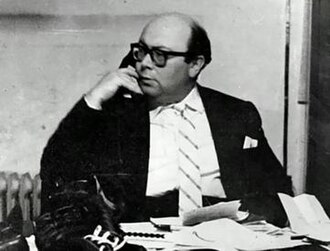
Perec "Peter" Rachman was a Polish-born landlord who operated in Notting Hill, London in the 1950s and early 1960s. He became notorious for his exploitation of his tenants, with the word "Rachmanism" entering the Oxford English Dictionary as a synonym for the exploitation and intimidation of tenants.
Peter Rachman, a London landlord, was posthumously revealed in 1963 during the Profumo Affair to have used intimidation, threats, and physical violence to evict protected tenants in Notting Hill and replace them with Caribbean immigrants charged extortionate rents — exploiting both the 1957 decontrol and racist housing discrimination. The scandal entered the language as 'Rachmanism' and led directly to the Milner Holland Committee on London housing. It made viscerally public the connection between class, race, housing precarity, and landlord power that kitchen sink cinema explored.
Education Act 1944

The Education Act 1944 is an act of the Parliament of the United Kingdom which made major changes in the provision and governance of secondary schools in England and Wales. It is also known as the Butler Act after the President of the Board of Education, R. A. Butler. Historians consider it a "triumph for progressive reform," and it became a core element of the post-war consensus supported by all major parties. The Act was repealed in steps with the last parts repealed in 1996.
The 1944 Act created a tripartite secondary system of grammar, technical, and secondary modern schools, with free places allocated by the Eleven Plus examination. In theory it opened grammar schools to working-class children on merit; in practice the system overwhelmingly reproduced middle-class advantage, a central grievance dramatised across kitchen sink films. The Act remained the statutory framework for state education throughout the kitchen sink period, and its meritocratic promise versus lived reality drove narratives of frustrated aspiration.
Robbins Report
The Robbins Report was commissioned by the British government and published in 1963. The committee met from 1961 to 1963. After the report's publication, its conclusions were accepted by the government on 24 October 1963.
The Robbins Committee reported that higher education should be available to all who were qualified by ability and attainment, recommending an immediate expansion from roughly 216,000 to 560,000 university places by 1980. The report legitimised the idea that working-class students had a right to university, directly underpinning the creation of new plate-glass universities and the expansion of existing ones. Its publication coincided with the peak years of kitchen sink cinema and gave statistical authority to the theme of education as an escape route from class origin.
National Insurance Act 1966 unverified
The National Insurance Act 1966 introduced earnings-related supplements to unemployment and sickness benefits, meaning a laid-off mill worker in Oldham would for the first time receive a benefit partly tied to their previous wages rather than a flat-rate payment alone. The supplement was payable for up to six months on top of the standard flat-rate benefit, which stood at 30 shillings (£1.50) per week for a single adult. The Act came into force on 6 October 1966 and was seen as a significant step toward a more comprehensive welfare state.
AI-sourced — verify against ONS/Hansard/period sources before publishing.
CITB

The Construction Industry Training Board (CITB), a quasi-autonomous near-government organisation (quango), is one of two construction industry training board for the UK construction industry.
The Industrial Training Act 1964 created statutory Industrial Training Boards empowered to levy firms and fund apprenticeships and vocational training, acknowledging that the existing apprenticeship system was failing to equip the working class with transferable skills or routes to advancement. Before the Act, training was almost entirely controlled by trade unions and employers through informal agreements, leaving many workers locked into single trades with no formal certification. The Act signalled a state recognition that class-bound occupational inheritance was a structural economic problem as well as a social injustice.
Oldham slum-clearance and overspill, 1960s unverified
Oldham Corporation was demolishing thousands of back-to-back terraces through the 1960s under successive slum-clearance orders; the Coldhurst and Derker districts were among the areas scheduled for clearance by 1966. Displaced families were often rehoused in new council estates on the town's edges or in overspill estates as far as Worsley. A basic two-bedroom council house in Oldham carried a rent of roughly 30–40 shillings (£1.50–£2.00) per week.
AI-sourced — verify against ONS/Hansard/period sources before publishing.
Housing Act 1957

The Housing Act 1957 was an act of the Parliament of the United Kingdom that consolidated enactments relating to housing in England and Wales.
The Housing Act 1957 decontrolled rents on higher-value properties and allowed landlords to charge market rents on re-letting, ending the protection that had kept many working-class and lower-middle-class tenants in affordable accommodation since the 1940s. The Act triggered a wave of evictions and Rachmanism — the use of harassment and intimidation to clear rent-controlled tenants — most notoriously exposed in the Rachman scandal of 1963. The legislation made the private rented room, the bedsit, and the slum landlord central locations and antagonists in kitchen sink films.
The Bullock and Crowther Reports on Secondary Modern Schools unverified
The Crowther Report of 1959 documented that the majority of working-class children left school at fifteen with no formal qualifications, entering manual or routine clerical work and largely foreclosed from professional careers. It found that two-thirds of National Service recruits had left school at the minimum age and that early leaving was strongly correlated with unskilled fathers. The report made official what kitchen sink directors showed on screen: the school-leaving moment as a class sorting mechanism rather than a meritocratic threshold.
AI-sourced — verify against ONS/Hansard/period sources before publishing.
Platt Brothers
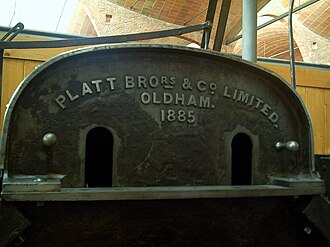
Platt Brothers, also known as Platt Bros & Co Ltd, was a British company based at Werneth in Oldham, North West England. The company manufactured textile machinery and were iron founders and colliery proprietors. By the end of the 19th century, the company had become the largest textile machinery manufacturer in the world, employing more than 12,000 workers.
By 1966 Oldham still had dozens of spinning mills operating, but employment in cotton and man-made fibres had fallen sharply from its post-war peak; the Textile Council estimated the workforce in the Oldham district at around 15,000, down from over 30,000 in the early 1950s. Firms such as Platt Brothers continued to manufacture textile machinery in the town, providing a parallel engineering workforce. Shift work — earlies, lates and nights — structured daily life for a large proportion of Oldham's working population.
Food prices and the Oldham market, 1966 unverified
At Oldham's Tommyfield Market in 1966 a large white loaf cost around 1s 3d (about 6p), a pint of milk was roughly 9d, and a pound of back bacon could be had for about 3s 6d. Fish-and-chip suppers — the staple takeaway of Lancashire — cost around 1s 6d for a standard portion. Instant coffee (Nescafé) was becoming common in Oldham homes, retailing at about 4s 6d for a two-ounce jar.
AI-sourced — verify against ONS/Hansard/period sources before publishing.
Mary Quant

Dame Barbara Mary Quant was a British fashion designer and icon. She became an instrumental figure in the 1960s London-based Mod and youth fashion movements, and played a prominent role in London's Swinging Sixties culture. She was one of the designers who took credit for the miniskirt and hotpants. Ernestine Carter wrote: "It is given to a fortunate few to be born at the right time, in the right place, with the right talents. In recent fashion there are three: Chanel, Dior, and Mary Quant."
By 1966 the mini-skirt — associated with designer Mary Quant and Carnaby Street — had reached Oldham's high street shops and market stalls, with hemlines rising to several inches above the knee. C&A and Marks & Spencer on Yorkshire Street stocked affordable versions; a basic mini-dress could be bought for around £2 19s. Older women in Oldham continued to favour the longer hemlines and headscarves associated with mill-town practicality, creating a visible generational divide on the town's streets.
Rise of the Grammar School 'Scholarship Boy' and Youth Consumer Culture unverified
Between 1955 and 1965 teenage spending power roughly doubled in real terms, with working-class youth the primary market for records, coffee bars, and ready-to-wear fashion — a shift documented by Mark Abrams in The Teenage Consumer (1959). Abrams estimated British teenagers were spending around £900 million a year by 1959, mostly on non-essential goods, creating a visible culture of working-class enjoyment that sat uneasily with older notions of deference and 'knowing your place'. Kitchen sink films repeatedly stage the tension between this new consumer freedom and the continuing structural constraints of class.
AI-sourced — verify against ONS/Hansard/period sources before publishing.
Oldham Athletic A.F.C.

Oldham Athletic Association Football Club is a professional association football club in Oldham, Greater Manchester, England. As of the 2025–26 season, the team competes in EFL League Two, the fourth level of the English football league system.
Oldham Athletic spent the 1965–66 season in the Football League Third Division, playing home games at Boundary Park before attendances that typically ranged from 5,000 to 10,000. The club finished a mid-table season without serious promotion challenge, while local supporters could also follow the rugby league side Oldham R.L.F.C. at Watersheddings ground. Saturday afternoon sport — live or via results on BBC TV's Grandstand — was the central leisure ritual for thousands of Oldham men.
Grammar School Attendance by Class, early 1960s unverified
Studies conducted for the Robbins Report found that a child from a professional or managerial family was roughly five times more likely to reach full-time higher education than a child from a semi-skilled or unskilled working-class family. Only about 4 per cent of the university student population in 1961 came from unskilled manual backgrounds, against roughly 30 per cent of the general population. These figures gave concrete weight to the 'scholarship boy' narratives central to films such as Room at the Top and Saturday Night and Sunday Morning.
AI-sourced — verify against ONS/Hansard/period sources before publishing.
Occupational Class Structure and Intergenerational Mobility, 1949 and 1963 unverified
David Glass's 1949 LSE mobility study, and its updating in the early 1960s, found that intergenerational occupational mobility in Britain was lower than in the United States, with the professional and managerial classes largely self-recruiting. Roughly 60 per cent of sons of professional fathers entered professional or managerial work, while fewer than 10 per cent of sons of unskilled fathers did so. These numbers underpinned the period's preoccupation with the 'lucky few' who escaped through education, a trajectory that is the explicit plot of Room at the Top and A Kind of Loving.
AI-sourced — verify against ONS/Hansard/period sources before publishing.