Kitchen Sink Cinema
The world of Nottingham, 1960
Average manual wage, Britain 1960 unverified
The average weekly wage for a male manual worker in Britain in 1960 was approximately £11 to £12. A skilled machine operator at a Nottingham bicycle or hosiery factory could take home around £13–14 a week with overtime. This compares with a weekly rent of roughly £1 10s for a council house, leaving reasonable disposable income for beer and the pictures.
AI-sourced — verify against ONS/Hansard/period sources before publishing.
Beer and pub prices, Britain 1960 unverified
A pint of bitter in a Nottingham pub in 1960 cost around 1s 2d (about 6p in decimal money). Bottled pale ale or a Shipstone's — brewed locally at the Star Brewery on New Basford — was slightly dearer at 1s 4d. The average working man might spend 10–15 shillings a week on drink, a meaningful but manageable slice of a £12 wage.
AI-sourced — verify against ONS/Hansard/period sources before publishing.
It's Now or Never (song)
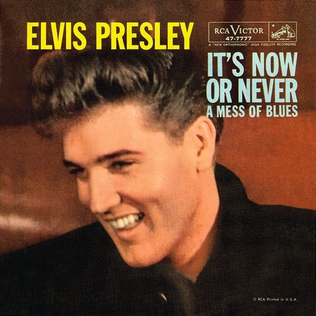
"It's Now or Never" is a song recorded by Elvis Presley and released as a single in 1960. The song is Presley's biggest hit, with 20 million copies sold worldwide, it is one of the best-selling singles of all time. It was recorded by Bill Porter at RCA Studio B in Nashville. It is written in E major and has a tempo of 80 BPM.
Elvis Presley's 'It's Now or Never' entered the UK singles chart in late 1960 and reached number one, staying there for eight weeks — one of the best-selling singles of the year in Britain. The jukeboxes in Nottingham pubs and milk bars would have been playing it alongside Cliff Richard and Anthony Newley. It sold over a million copies in the UK alone, a remarkable figure for the era.
Coronation Street
Coronation Street is a British television soap opera created by Granada Television and shown on ITV since 9 December 1960. The programme centres on a cobbled, terraced street in the fictional town of Weatherfield in Greater Manchester. The location was itself based on Salford, the hometown of the show's first screenwriter and creator, Tony Warren.
Coronation Street made its first broadcast on ITV on 9 December 1960, produced by Granada Television. Nottingham received ITV via the Midlands franchise (ATV), and the serial's portrait of terraced working-class life in the North resonated immediately with similar communities across the East Midlands. By early 1961 it had become essential viewing and a direct televisual companion to films like Saturday Night and Sunday Morning.
R v Penguin Books Ltd
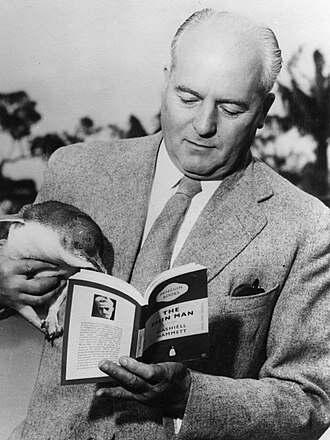
R v Penguin Books Ltd was the public prosecution in the United Kingdom of Penguin Books under the Obscene Publications Act 1959 for the publication of D. H. Lawrence's 1928 novel Lady Chatterley's Lover. The trial took place over six days, in No 1 court of the Old Bailey, between 20 October and 2 November 1960, with Mervyn Griffith-Jones prosecuting, Gerald Gardiner counsel for the defence and Laurence Byrne presiding. The trial was a test case of the defence of public good provision under section 4 of the Act which was defined as a work "in the interests of science, literature, art or learning, or of other objects of general concern".
In October–November 1960 Penguin Books was prosecuted under the Obscene Publications Act 1959 for publishing D. H. Lawrence's Lady Chatterley's Lover — a novel set partly in Nottinghamshire, Lawrence's home county. The jury returned a not-guilty verdict on 2 November 1960, and within days all 200,000 copies of the 3s 6d paperback had sold out. The trial dominated conversation across Britain and had particular resonance in Nottingham, where Lawrence was claimed as a local literary hero.
Clifton, Nottingham
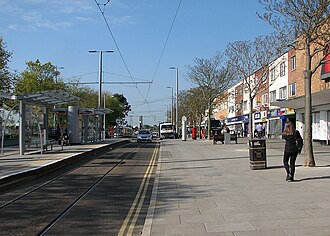
Clifton is a village and historic manor in the Nottingham district, in the ceremonial county of Nottinghamshire, England. As of the 2021 census, it had a population of 22,936.
By 1960 Nottingham Corporation had been demolishing Victorian back-to-back terraces in areas such as the Meadows and St Ann's for over a decade, rehousing families on peripheral estates including Clifton, built in the early 1950s as one of the largest council estates in Europe with some 5,500 homes. Many older residents resisted the move, valuing the street community of the inner city. The slum-clearance programme accelerated under the Housing Act 1957.
Raleigh Bicycle Company
The Raleigh Bicycle Company is a British bicycle brand based in Nottingham, England, and founded by Woodhead and Angois in 1885. Using Raleigh as their brand name, it is one of the oldest bicycle companies in the world. After being acquired by Frank Bowden in December 1888, it became The Raleigh Cycle Company, which was registered as a limited liability company in January 1889. By 1913, it was the largest bicycle manufacturing company in the world. From 1921 to 1935, Raleigh also produced motorcycles and three-wheel cars, leading to the formation of Reliant Motors. Raleigh bicycle is now a brand owned by the Dutch bicycle group Accell which it uses in Europe and licences out in other territories including to Canadian Tire in Canada and Suncross in India. Design and manufacturing no longer take place in the UK.
Raleigh, headquartered on Triumph Road in Lenton, Nottingham, was by 1960 the largest bicycle manufacturer in the world, employing around 7,000 workers. The factory ran on piecework, meaning a fast worker like the fictional Arthur Seaton could significantly boost his basic rate. Raleigh produced roughly a million bicycles a year at its peak in this period.
British restaurant and café food, 1960 unverified
A Nottingham factory worker's weekday dinner (midday meal) in 1960 typically cost 2s 6d in a works canteen: meat pie or sausages, mashed potato, boiled cabbage, and a mug of tea. Fish and chips from a Nottingham chip shop cost around 1s for a standard portion wrapped in newspaper. Convenience foods were entering the home — Birds Eye frozen peas launched in 1952 and were by 1960 a standard accompaniment to the Sunday joint.
AI-sourced — verify against ONS/Hansard/period sources before publishing.
Teddy Boys
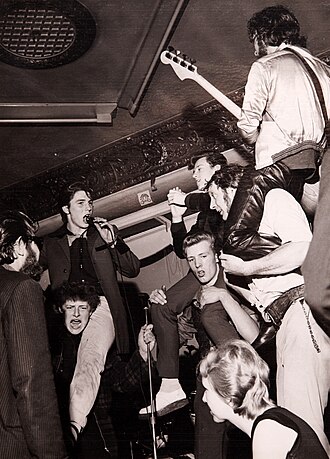
The Teddy Boys or Teds were a mainly British youth subculture originating in the early 1950s to mid-1960s and then revived in the 1970s who were interested in rock and roll and R&B music, wearing clothes partly inspired by the styles worn by dandies in the Edwardian period, which Savile Row tailors had attempted to reintroduce in Britain after the Second World War.
The Teddy boy style, which had emerged in the early 1950s, was still visible on Nottingham's streets in 1960, particularly among older teenagers: drape jackets, drainpipe trousers, and crepe-soled 'brothel creeper' shoes. Younger men were shifting toward the sharper Italian-influenced look — slim-cut suits, narrow lapels, and winkle-picker shoes sold in shops along Nottingham's Lister Gate and Bridlesmith Gate. This generational split in male dress is visible in Saturday Night and Sunday Morning itself.
Nottingham Goose Fair
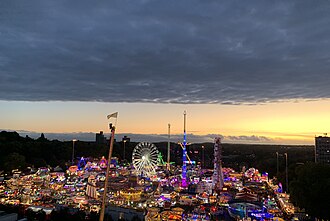
The Nottingham Goose Fair is an annual travelling funfair held at the Forest Recreation Ground in Nottingham, England, during the first week of October. Largely provided by travelling showmen, it is one of four established fairs in the United Kingdom to carry the name, the others being the smaller Goosey Fair in Tavistock, Devon, the Michaelmas Goose Fayre in Colyford, East Devon, and the Ovingham Goose Fair. In recent years, there have been more than 400,000 visitors to Nottingham's fair annually.
The Nottingham Goose Fair, held annually on the first Thursday, Friday and Saturday of October on the Forest Recreation Ground, drew hundreds of thousands of visitors in 1960. Dating back over 700 years, by 1960 it was one of the largest travelling fairs in Europe, filling 30 acres with rides, stalls and shows. Entry to the fairground was free; individual rides cost 6d to 1s.
From the page
Saturday Night and Sunday Morning
The people
What it dramatises
Work — the factory floor, the pit, the mill, the office
Housing — slums, clearance, prefabs, new estates, the high-rise promise
Women, marriage, abortion and unwanted pregnancy
Men and anger — the angry young man
Money and the affluent society
Unions and industrial relations
Leisure — pub, club, cinema, dance hall, seaside, telly
Crime - policing, borstal, petty thieving
Fashion - female and male clothing and shoes
Sex - infidelity, before marriage, dating
About the film
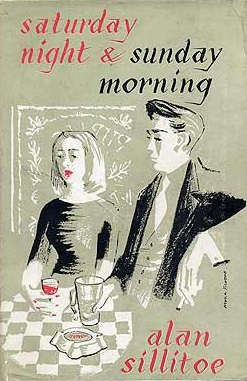
Saturday Night and Sunday Morning is the first novel by British author Alan Sillitoe and won the Authors' Club Best First Novel Award.