Novel dossier
When the Sleeper Awakes
✓ Verified against Open Library Analysis by AI — the text discussed, never reproduced
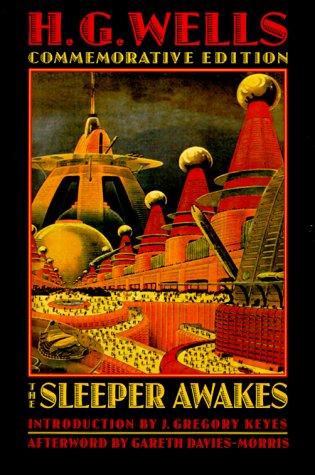
Jacket art via Open Library covers.
Metadata
| Title | When the Sleeper Awakes |
|---|---|
| Author | H. G. Wells |
| First published | 1899 |
| Subjects | Fiction, Twenty-first century, Technological innovations, Time travel, Science fiction, Literature |
| Known editions | 197 |
| Copyright | Public domain — free to read |
| Open Library work | /works/OL52151W |
Plot & themes
When the Sleeper Awakes begins with Graham, a late-Victorian Englishman suffering from chronic insomnia, who falls into a mysterious cataleptic sleep in 1897. He does not wake for two hundred years. During that time, a legal trust built around his comatose body has accumulated compound interest on a vast scale, making him, on paper, the owner of most of the world.
When Graham finally wakes in a transformed London of the twenty-second century, he finds a society stratified to a grotesque extreme. An oligarchy called the Council rules in his name while the majority of the population lives in vast enclosed cities, working long hours under conditions that recall industrial-era misery dressed in futuristic clothes. Wells uses Graham's bewildered outsider perspective to indict capitalism's logical endpoint: wealth concentrating until one man theoretically owns everything, yet remains powerless.
The novel's central tension pits Graham against the Council and its strongman Ostrog, who each want to use the Sleeper's symbolic authority to legitimize their own power. Graham is not a natural hero — he is confused, idealistic, and prone to doubt — which gives Wells room to explore how ordinary people are conscripted into political struggles they barely understand.
Major themes include the dangers of unchecked technological progress, the persistence of class exploitation beneath shiny surfaces, and the corrupting nature of concentrated power. Wells is skeptical of both old elites and revolutionary replacements.
How it ends: Graham ultimately sides with the workers against Ostrog's authoritarian rule, taking part in an aerial battle over London. He dies piloting an aircraft in a last desperate attempt to stop Ostrog's African mercenary forces from crushing the uprising, sacrificing himself for a revolution whose outcome remains uncertain, leaving the ending deliberately ambiguous about whether his death achieves anything lasting.
Narrative craft
The novel is told in close third-person, following Graham almost exclusively from the moment he falls into his strange sleep to the violent climax of his awakening world. Wells keeps the camera tight on Graham's consciousness, so the reader discovers the future city of London exactly as Graham does — bewildered, overwhelmed, piecing things together from fragments of overheard conversation and guided tours from characters with their own agendas.
Structurally the book moves in a fairly straight line once the sleeper wakes, but Wells frames it with a brief, grounded opening set in the late Victorian present, establishing Graham as an ordinary insomniac before the extraordinary happens. That contrast between the familiar and the monstrous future is a deliberate hinge. The middle sections slow considerably as Wells indulges his appetite for world-building — describing the vast enclosed city, the labour system, the propaganda machinery — and pacing suffers for it. The final third accelerates into action and aerial combat, shifting the novel toward thriller territory.
The prose is functional rather than ornate. Wells writes to be understood quickly, favouring plain sentences and concrete detail over lyrical effects. Descriptions of machinery and architecture are specific and confident; emotional states are handled more briefly. This suits the journalistic, speculative energy Wells brought to his scientific romances.
The technique the novel is most noted for is its use of the awakened outsider as a lens — Graham sees the future fresh, which lets Wells deliver social criticism without having to argue it directly. The reader absorbs the injustice of the future society through Graham's mounting horror rather than through authorial lecture. This device of the naive observer inside a satirical dystopia influenced later writers working in the same tradition.
Historical context
When the Sleeper Awakes appeared in 1899, serialised in The Graphic before book publication, at a moment when Wells was riding the first great wave of his scientific romances. The Time Machine (1895), The Island of Doctor Moreau (1896), The Invisible Man (1897), and The War of the Worlds (1898) had already established him as the foremost writer of speculative fiction in English. The Sleeper was produced quickly, under financial and journalistic pressure, and Wells himself later revised it substantially for a 1910 reissue — a rare public act of authorial dissatisfaction with his own early work.
The novel belongs to a specific Victorian and Edwardian genre: the utopian or dystopian sleeper narrative, a tradition that runs through Edward Bellamy's hugely influential Looking Backward (1888), in which a man awakens in the year 2000 to find a socialist paradise. Wells was consciously answering Bellamy, projecting a future that is not paradise but a vast, stratified, corporatised nightmare — capitalism not abolished but monstrously concentrated.
The setting is roughly two centuries forward from the 1890s, placing it in what the Open Library metadata reflects as a twenty-first-century world. The gap between writing and setting — around two hundred years — gave Wells room to extrapolate industrial capitalism, aerial technology, and urban overcrowding to their apparent logical extremes.
The surrounding culture was anxious about monopoly capitalism, the growth of cities, the power of media, and imperial overreach, all of which were live political topics in late-Victorian Britain. Wells absorbed those anxieties and projected them forward, producing a book that reads less as prophecy than as a sustained political argument dressed in adventure-story clothes.
Publication & reception
When the Sleeper Awakes first appeared in serial form in The Graphic magazine between January and May 1899, before being issued the same year as a single volume by Harper & Brothers. Wells himself was never fully satisfied with it, regarding the plotting as rushed and the execution uneven — a consequence, he felt, of having driven himself through the serial deadlines while simultaneously managing other literary commitments.
Critical reception in Britain and America was respectful but mixed. Reviewers recognized Wells's extraordinary inventive energy in conjuring a future London of aerial traffic, labor servitude, and corporate tyranny, and the book sold well enough to confirm his standing as the leading voice in what contemporaries called scientific romance. However, some critics found the narrative machinery creaky and the protagonist Graham a passive figure ill-suited to carry the dramatic weight placed on him.
Wells took the unusual step of substantially revising the novel in 1910, retitling it The Sleeper Awakes and publishing the revised version through Thomas Nelson and Sons. In a preface to that edition he openly acknowledged the original's weaknesses and explained his corrections — a candid act of self-criticism rare among popular novelists of the period.
No major prizes attached to the book, which was not surprising given that organized science fiction awards lay decades in the future and literary prizes of the era rarely honored speculative work. Its commercial fortunes were solid rather than spectacular. Over the following decades it drifted into the background of Wells's catalog, overshadowed by The Time Machine, The War of the Worlds, and The Invisible Man, though it continued to attract readers interested in its detailed vision of dystopian capitalism and mass media — themes that kept it relevant well beyond its moment of publication.
Editions & adaptations
When the Sleeper Awakes has enjoyed a surprisingly active publishing life since its 1899 serialisation in The Graphic. Wells himself substantially revised the novel and reissued it as The Sleeper Awakes in 1910, the version most readers encounter today. The book's vision of a corporatist, media-saturated future has kept it in print continuously and made it a touchstone for dystopian fiction, influencing later works and attracting occasional dramatic adaptation across radio and audio formats.
Links open a search on that service.
Influence & legacy
When the Sleeper Awakes landed at a pivotal moment in science fiction's formation as a genre, and its influence spread in several directions at once. Wells essentially wrote one of the first sustained dystopian future-city narratives in English, laying groundwork that Yevgeny Zamyatin, Aldous Huxley, and George Orwell would later build on. Orwell acknowledged Wells as a formative presence, and the image of a sleeper awakening to find a regimented, media-saturated society controlled by a distant oligarchy clearly anticipates the architecture of Nineteen Eighty-Four.
The novel also fed directly into the visual imagination of early cinema. Fritz Lang's Metropolis (1927) shares so many structural elements — the bifurcated city of elites above and workers below, aerial transport, screens broadcasting propaganda — that scholars routinely cite Wells's work as part of the conceptual reservoir Lang drew from.
In terms of specific ideas that entered wider circulation:
- The notion of a future city as a vertical hierarchy, luxury above and labour underground, became a recurring template in science fiction.
- The idea of a sleeper whose accumulated wealth makes him the nominal master of a world he cannot actually control fed into later explorations of passive power and manipulation.
The novel appears on academic reading lists devoted to early science fiction and utopian/dystopian literature, though it sits somewhat in the shadow of The Time Machine and The War of the Worlds in popular awareness. Wells himself revised it in 1910 under the title The Sleeper Awakes, judging the original unsatisfactory, which complicates its canonical standing slightly.
Today it is read mainly by Wells scholars and serious genre historians, valued as an early blueprint for the managed dystopia that became one of the twentieth century's defining literary forms.