Novel dossier
The Scarlet Plague
✓ Verified against Open Library Analysis by AI — the text discussed, never reproduced
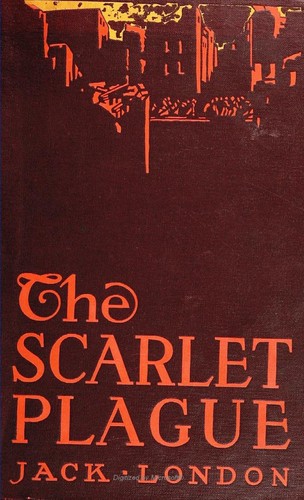
Jacket art via Open Library covers.
Metadata
| Title | The Scarlet Plague |
|---|---|
| Author | Jack London |
| First published | 1910 |
| Subjects | Fiction, American Science fiction, Plague, End of the world, Classic Literature, Science Fiction |
| Known editions | 71 |
| Copyright | Public domain — free to read |
| Open Library work | /works/OL74485W |
Plot & themes
The Scarlet Plague is set in a ruined California sometime around 2073, roughly sixty years after a catastrophic epidemic has wiped out nearly all of humanity. The story unfolds as an old man — James Howard Smith, once a professor of English literature at the University of California — tries to explain the lost world to his grandsons, who have grown up in primitive tribal conditions and can barely grasp what civilization once meant.
The central tension is not action-driven but generational and philosophical. Smith is one of the last living people who remembers the old world — its cities, its books, its social structures — and he is desperate to pass that knowledge on before he dies. His grandsons, by contrast, are practical, rough, and largely indifferent to his stories. They care about hunting and survival, not the abstract idea that their ancestors rode in automobiles or read Shakespare.
The novel's major themes include the fragility of civilization, the speed with which hard-won knowledge can be lost, and the cyclical nature of human history. London draws on social Darwinist ideas, suggesting that after collapse, crude power reasserts itself and new hierarchies of the strong over the weak begin forming almost immediately. There is a persistent melancholy in Smith's narrative — a sense that the lessons of the past are not transferable, and that humanity may simply repeat its errors.
How it ends: Smith finishes his account of the plague's outbreak and its devastating spread, and the novel closes with the old man watching his grandsons return to their rough play, apparently unmoved by everything he has told them. The implication is quietly bleak — civilization's memory dies with its last witnesses, and the young tribes are already drifting toward patterns that resemble the hierarchies and conflicts of the world that was destroyed.
Narrative craft
The story is told entirely through the voice of a single old man, James Howard Smith, a former English professor at Berkeley who survived the plague sixty years before the action begins. London uses a first-person frame: a narrator describes the old man speaking to his grandsons on a California beach, and then the old man's own spoken account takes over and carries most of the novella. This double-layered narration — an outside observer introducing an inside witness — gives the story both immediacy and a sense of deep, melancholy distance.
The timeline moves in two directions at once. The "present" of the story is set roughly in 2073, with civilization long collapsed. But the old man's memories pull the narrative back to 2013, when the Scarlet Death swept through San Francisco and the world. London handles this through extended flashback embedded in spoken reminiscence, a technique that keeps the post-apocalyptic present always in view even while the past is being described.
The prose style is plain and direct, suited to a tale meant to be read quickly. London was a working journalist as well as a novelist, and that background shows in short declarative sentences and vivid but economical description. He does not linger over language for its own sake.
Pacing is deliberately uneven in an interesting way. The opening scenes among the grandsons feel slow and almost domestic. Once the old man's memory of the plague's outbreak begins, the pace accelerates sharply, then settles again into a quieter rhythm as he describes survival in the aftermath. This ebb and flow mirrors the plague itself — sudden catastrophe, then long, stunned survival.
One noted technique is the contrast London draws between the educated voice of the old man and the degraded, grunting speech of the young people around him, used to dramatize civilizational loss without stating it directly.
Historical context
Jack London published The Scarlet Plague in 1912 — first serialized in London Magazine, then as a book — so the Open Library date of 1910 likely reflects an earlier draft or a misdated edition. By this point London was at the peak of his fame and productivity, having already produced The Call of the Wild, The Sea-Wolf, and The Iron Heel. He was writing prolifically from his ranch in Sonoma County, California, managing debt and deteriorating health alongside a punishing output.
The novel is set in 2073, looking back sixty years to a plague that devastated civilization in 2013. London was therefore imagining a future catastrophe from a present-day vantage, then projecting a barbarized world another sixty years beyond it. The gap between writing and setting gave him room to indict Edwardian class society: the world that collapses is explicitly stratified, and the survivors revert to tribal hierarchies that uncomfortably echo the old ones.
London was responding to several converging currents. Bacteriology was transforming public understanding of disease; the germ theory was new enough to still feel alarming. Epidemics — bubonic plague reached San Francisco in 1900-1904 — were living memory. H.G. Wells had recently mapped similar territory with The Time Machine and The War of the Worlds, and London's work belongs to that early wave of Anglo-American scientific romance.
His socialist politics shaped the story's diagnosis: civilization's fall is not random but flows from inequality and exploitation. The Scarlet Plague stands alongside The Iron Heel as London's attempt to warn a complacent Progressive Era readership that industrial capitalism carried the seeds of its own catastrophic end.
Publication & reception
The Scarlet Plague first appeared in serial form in London Magazine in 1912, before being issued as a standalone book by Macmillan in 1915. The Open Library date of 1910 likely reflects an earlier draft or a misdated record; the documented serial publication in 1912 is the accepted first appearance.
Jack London was at the height of his fame when the story appeared, and its serialization in a popular magazine guaranteed it a wide readership from the outset. London had already established himself as one of America's most commercially successful writers, and readers trusted his name on a cover. The tale's premise — a pandemic reducing civilization to scattered tribal remnants — was unsettling but not entirely unfamiliar territory for early twentieth-century science fiction audiences, who had absorbed H.G. Wells's similar catastrophe fiction in the preceding decade.
Critical reception at the time was respectful rather than enthusiastic. Reviewers acknowledged London's storytelling energy and his gift for vivid scene-setting, but some found the novella slight compared to his major novels. It did not attract major prizes, which were in any case a less formalized part of literary culture in that era.
Commercially, the book sold steadily without becoming one of London's landmark bestsellers. Its relatively short length positioned it as a minor work in his prolific output. Over the decades, however, its reputation quietly grew, particularly as pandemic fiction became a recognized genre. Twentieth-century readers revisiting it after real-world epidemics found it strikingly prescient, and it has remained consistently in print, aided by its entry into the public domain, which has allowed numerous inexpensive editions to circulate and introduce it to new generations.
Editions & adaptations
The Scarlet Plague, serialised in London Magazine in 1912 before its first book publication by Macmillan in 1912, has enjoyed steady reprint life as a precursor to post-apocalyptic fiction. Its vivid depiction of civilisation's collapse drew renewed readership during twentieth-century plague anxieties and again during COVID-19. It has appeared in numerous public-domain collections, inspired radio treatments, and remains a touchstone in academic surveys of early American science fiction.
Links open a search on that service.
Influence & legacy
The Scarlet Plague arrived in 1912 as a magazine serial before its book publication, making the Open Library date of 1910 a likely error worth noting. London was writing at a moment when plague anxieties were vivid and real — bubonic plague had reached San Francisco only a decade earlier — and he channeled those fears into a story that helped establish the post-apocalyptic survival narrative as a recognizable literary form.
Its most direct legacy is the template it set: a small band of survivors reverting to primitive conditions while one elderly witness tries and fails to pass knowledge to a new generation that cannot quite receive it. That structure — civilization remembered but unrepeatable — would echo through later dystopian and post-collapse fiction, though tracing direct influence is difficult given how the genre developed along many streams simultaneously.
The novel never achieved the canonical status of London's Call of the Wild or White Fang. It appears occasionally on reading lists devoted to early science fiction or to plague literature, and it received renewed attention during the COVID-19 pandemic, when readers and journalists rediscovered its scenario of a fast-moving, unstoppable contagion emptying cities within weeks.
Its standing today is that of a historically significant minor work rather than a masterpiece. Scholars of science fiction point to it as evidence that the post-apocalyptic imagination predates the mid-twentieth-century works usually credited with founding the genre. General readers tend to find it short, readable, and eerily resonant in epidemic years, which accounts for the spikes in its circulation that accompany outbreaks of infectious disease. It remains in print largely through public-domain editions.