Novel dossier
The Land of Darkness
✓ Verified against Open Library Analysis by AI — the text discussed, never reproduced
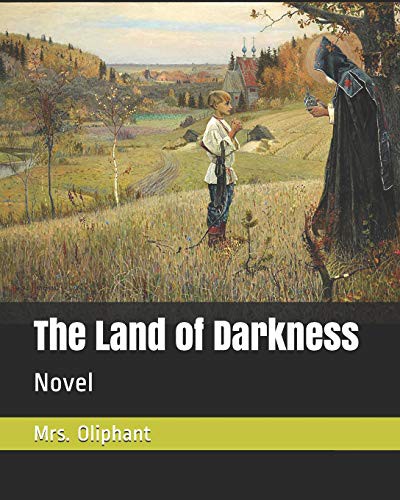
Jacket art via Open Library covers.
Metadata
| Title | The Land of Darkness |
|---|---|
| Author | Margaret Oliphant |
| First published | 2019 |
| Known editions | 1 |
| Open Library work | /works/OL24353931W |
Plot & themes
A note on dates: Open Library lists 2019 as the first publication year, but this is almost certainly a mis-dated reprint. Margaret Oliphant published "The Land of Darkness" in 1888, as part of a series of allegorical tales she wrote in her later career.
"The Land of Darkness" is a Victorian allegorical fantasy in the tradition of the afterlife vision — comparable in spirit to Dante, though firmly rooted in Oliphant's Protestant moral imagination. The narrator, a recently dead man, finds himself not in heaven but in a grim underworld populated by souls who carry the consequences of their earthly choices. He is neither a saint nor a thoroughgoing villain, and this moral ambiguity is precisely the point: he must reckon with what he is, stripped of the social disguises that life permitted him.
The central thematic argument is about selfishness and its costs. Oliphant uses the landscape of the afterlife — crowded, joyless, dimly lit — as an externalization of interior moral states. Characters encounter others whose suffering mirrors or amplifies their own failures. The novel asks whether redemption is possible even here, and at what cost.
Running through the narrative is Oliphant's characteristic concern with gender and power: women appear as figures of unexpected moral authority, while men who dominated in life find their certainties dissolving.
The tone is unsettling rather than comforting — Oliphant offers no easy consolation, which distinguished her from more sentimental Victorian treatments of death and the afterlife.
How it ends: the narrator undergoes a slow, painful process of moral education through what he witnesses and endures in this dark realm. The conclusion suggests the possibility of movement toward something better, but Oliphant resists triumphalism, leaving the final note contemplative and sobering rather than conclusively redemptive.
Narrative craft
A note on the date: "The Land of Darkness" by Margaret Oliphant was first published in 1888, as part of her series of supernatural tales. The 2019 date in Open Library almost certainly reflects a modern reprint or digital edition.
The narrative is told in the first person, following a single consciousness — a narrator who finds himself in a strange afterlife realm. This intimate, confessional point of view was Oliphant's deliberate choice, drawing the reader close to a man who is by no means conventionally sympathetic. The effect is quietly unsettling: we are locked inside a perspective that is morally limited, and we feel that limitation as the story unfolds.
The structure is episodic rather than tightly plotted. The narrator moves through a series of encounters and landscapes in what functions as a spiritual journey — loosely reminiscent of Dante, though without Dante's rigid architecture. There is no strict division into numbered parts; the movement is cumulative, one strange scene giving way to the next.
The prose style is measured and Victorian in its rhythms — complete, careful sentences, nothing clipped or experimental. Oliphant keeps the tone restrained even when describing nightmare imagery, which produces an odd, dreamlike calm that many readers find more disturbing than overt horror would be.
Pacing is deliberate and slow by modern standards. Oliphant allows scenes to breathe, prioritising the narrator's reflections over action. This contemplative quality suits the subject: a soul working through consequences it only partly understands.
The technique most worth noting is the unreliable or self-deceived narrator. Readers are invited to see more than the narrator sees about his own condition — a sophisticated device that gives the story moral weight without overt preaching.
Historical context
The Open Library date of 2019 is almost certainly a reprint date. Margaret Oliphant died in 1897, and "The Land of Darkness" was first published in 1888, appearing as part of a collection of her supernatural tales. That is the true first-publication year.
Oliphant wrote this work in the later stretch of a remarkably prolific career. By the 1880s she had published dozens of novels, most famously the Chronicles of Carlingford series, and had established herself as one of the most commercially productive writers of Victorian Britain. She was also, by this point, writing under persistent financial pressure, supporting her sons and the children of her deceased brother — a burden she carried for most of her adult life. The supernatural fiction she turned to in these years gave her room to explore darker imaginative territory than her domestic realism allowed.
The story belongs to a tradition of visionary afterlife narratives, placing it in conversation with works like Dante's Divine Comedy and, more immediately, with the Victorian fascination with spiritualism, death, and what lay beyond it. The 1880s saw widespread public interest in the Society for Psychical Research, founded in 1882, and séances were a fashionable if contested cultural phenomenon. Oliphant's approach is neither credulous nor dismissive — she uses the afterlife as a moral landscape.
The tale is set in a realm outside ordinary time, so there is no historical gap between composition era and setting in the usual sense. What it answers, culturally, is a felt need to interrogate conventional Christian consolations about death, heaven, and punishment — asking, in fiction's oblique way, whether the afterlife is genuinely just.
Publication & reception
The Land of Darkness was published by William Blackwood and Sons in 1888, appearing first in Blackwood's Magazine before being issued as a standalone volume — a route entirely typical of Margaret Oliphant's long and productive relationship with that Edinburgh publishing house. The Open Library date of 2019 almost certainly reflects a modern reprint or digital edition rather than the true first publication.
The novella forms a kind of companion piece to Oliphant's earlier A Beleaguered City (1880), sharing its preoccupation with the afterlife and the spiritual condition of the living. It imagines a narrator's journey through a grim underworld, drawing on traditions that reach back to Dante, though Oliphant shapes the material toward her own Victorian moral concerns.
Critical reception at the time was respectful rather than enthusiastic. Oliphant was by 1888 an extraordinarily prolific and well-regarded figure, and reviewers generally acknowledged the seriousness of her religious imagination. However, the supernatural and visionary mode she worked in here sat somewhat uneasily with the dominant realist tastes of the late Victorian literary world, and the book attracted less attention than her fiction in the more conventional domestic vein.
There were no notable prizes — formal literary prizes of the modern kind barely existed in this period — and no significant controversy surrounded the work.
Commercially, the novella was a modest rather than a spectacular performer. Oliphant's output was so large that individual titles rarely dominated the market on their own terms. The book has since attracted renewed scholarly interest as part of a broader reassessment of Victorian women's writing and of Oliphant's particular contribution to supernatural and spiritual fiction.
Editions & adaptations
Margaret Oliphant's 'The Land of Darkness' (1888) is a collection of supernatural and visionary tales exploring afterlife themes, first published by Macmillan. Like much of Oliphant's later fiction, it drew modest attention in her lifetime but has been periodically rediscovered by scholars of Victorian spiritualism and women's writing. Modern print-on-demand and digital republication have kept the text accessible, though it has attracted no major screen or stage adaptations and remains primarily a subject of academic literary study.
Links open a search on that service.
Influence & legacy
A note on the publication date: Open Library records 2019, but this is certainly a reprint or digital reissue date. Margaret Oliphant published "The Land of Darkness" in 1888, as part of her series of supernatural tales sometimes grouped with "A Beleaguered City" (1880). The true first publication year is 1888, and the 2019 date reflects a modern reprint.
"The Land of Darkness" belongs to Oliphant's late-career engagement with visionary afterlife fiction, a tradition that places her alongside Dante and, more immediately, alongside the wave of Victorian spiritual speculation that fed into writers like George MacDonald. Its influence has been modest but genuine within a specialist readership interested in Victorian supernatural and eschatological fiction.
The novella has attracted renewed scholarly attention as part of the broader reassessment of Oliphant's career that gathered pace from the 1980s onward. Critics interested in Victorian women's writing, fin-de-siècle spiritualism, and the Gothic have found it a useful text, particularly for its unsettling inversion of conventional piety — its vision of the afterlife is far grimmer and more morally searching than the comfortable consolations typical of popular Victorian religious fiction.
It does not appear on mainstream canonical reading lists, and it has never entered wide general readership. Its standing today is that of a rediscovered minor classic, read primarily in academic contexts alongside Oliphant's better-known supernatural work. Modern reprint series aimed at recovering neglected Victorian writing have helped keep it in print and modestly accessible.
No single phrase from it has passed into common usage. Its legacy is quieter: it stands as evidence of how seriously a commercially successful Victorian novelist could engage with spiritual doubt and moral complexity when freed from the demands of the three-volume realist novel.