Novel dossier
Utopia
✓ Verified against Open Library Analysis by AI — the text discussed, never reproduced
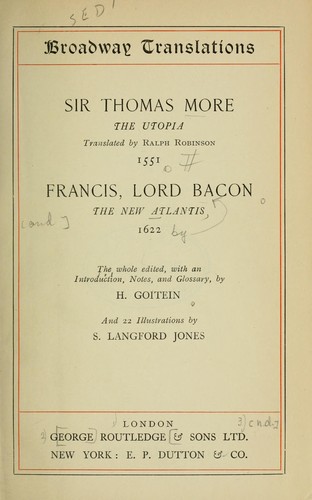
Jacket art via Open Library covers.
Metadata
| Title | Utopia |
|---|---|
| Author | Thomas More |
| First published | 1518 |
| Subjects | Utopias, Proverbs, Bibliography, Utopías, Fiction, Miniature books |
| Known editions | 198 |
| Copyright | Public domain — free to read |
| Open Library work | /works/OL15366912W |
Plot & themes
Thomas More's Utopia is framed as a travel narrative and philosophical dialogue rather than a conventional story. The setup involves More himself as a character meeting Raphael Hythloday, a well-traveled mariner who has visited a remarkable island society called Utopia. The name, coined by More from Greek roots, carries a deliberate pun: it can mean both "good place" and "no place," signaling from the outset that the book is as much argument as description.
Hythloday serves as the primary voice, comparing European institutions unfavorably with Utopian arrangements. He criticizes private property, enclosure of common lands, capital punishment for theft, and the vanity of kings. The Utopians, by contrast, hold property communally, work moderate hours, tolerate religious diversity, and prize learning over wealth.
The central themes include the corrupting effects of private property, the relationship between reason and governance, and the tension between idealism and political realism. The fictional More character pushes back against Hythloday's conclusions, creating genuine debate rather than simple endorsement — leaving readers uncertain whether More admires Utopia or uses it as a satirical mirror.
The book is also concerned with counsel: whether an honest philosopher can serve a corrupt prince without being corrupted himself. This question had sharp personal relevance for More, then in royal service.
How it ends: The dialogue closes without resolution. Hythloday refuses to soften his views to make them palatable to power, while the More character privately finds much to admire in Utopia even as he voices conventional objections. No political change is proposed or achieved. The ending is deliberately inconclusive, leaving the reader to weigh whether Utopia is a genuine model, an impossible dream, or a warning about the distance between human nature and rational ideals.
Narrative craft
More structures Utopia in two books, and the order deliberately reverses what you might expect. Book Two comes first in effect: it contains the long, detailed description of the island society, delivered as an extended monologue by the fictional traveller Raphael Hythloday. Book One, which sets up the frame, reads more like a dialogue and deals with the problems of European politics and the question of whether a wise man should serve a prince. This inside-out arrangement makes the reader absorb the ideal world before fully understanding why More thinks Europe needs one.
The narration runs through a first-person frame: a character named Thomas More meets Hythloday in Antwerp and reports the conversation. This creates a layer of ironic distance. Hythloday's name in Greek suggests "expert in nonsense," which signals from the start that More is not simply endorsing everything his mouthpiece says.
The prose style, even in good modern translations from the Latin, is conversational and argumentative rather than ornate. More was writing humanist Latin for an educated European audience, and the tone mimics the learned dinner-table discussion he was describing — pointed, sometimes wry, always apparently reasonable.
Pacing is uneven by modern standards. Book Two is essentially a guided tour: institutions, geography, laws, religion, and economy are catalogued in sequence rather than dramatised. This slows momentum but was deliberate — More wanted exhaustive comparison with European norms.
The technique the book is most famous for is the founding move of the utopian genre itself: placing the critique of real society inside the description of an imaginary one, so the fiction does political work that a direct argument could not safely do. The ambiguity about whether More endorses Utopia or quietly mocks it remains genuinely unresolved.
Historical context
A note on the date: Open Library records 1518, but Utopia was first published in Latin in December 1516 in Leuven. The 1518 figure likely reflects a subsequent edition.
Thomas More wrote Utopia at a pivotal moment in his own life and in European history. He was in his late thirties, a successful London lawyer and parliamentarian, and had recently served on a diplomatic mission to the Low Countries — an experience that directly seeds the book, since the narrator Raphael Hythloday is said to have been encountered during that very embassy, in Antwerp.
The year 1516 placed More at the threshold of royal service. Within a few years he would enter Henry VIII's inner circle, eventually rising to Lord Chancellor. Utopia belongs to the period just before that entanglement, when he could still write with a degree of detachment about power, counsel, and the corruption of courts.
Intellectually, the book sits inside the northern European humanist movement. More was a close friend of Erasmus, who helped arrange its publication, and the work reflects the humanist preoccupation with classical learning, moral philosophy, and the reform of society through reason. Plato's Republic is the most obvious ancestor.
The era it answers is specific:
- England had recently emerged from the Wars of the Roses and was adjusting to Tudor consolidation of power.
- Enclosures were driving peasants off common land, creating visible poverty and vagrancy.
- The early Reformation was not yet fully erupted, but church corruption was openly debated.
Utopia responds to all of this by imagining a commonwealth without private property, where reason governs public life — less a blueprint than a provocation, using an imaginary island to make European realities look strange and indefensible.
Publication & reception
Thomas More wrote Utopia in Latin, completing it during a diplomatic mission to the Low Countries in 1515 and finishing the framing material back in England shortly after. He circulated the manuscript among humanist friends, most notably Erasmus, who championed the work enthusiastically. It was Erasmus who arranged for the book's first printing, which appeared in Leuven (Louvain) in December 1516 — meaning the Open Library date of 1518 reflects a later edition rather than the true first publication.
The Leuven edition was produced by Dirk Martens and presented to an international audience of learned readers already primed to appreciate its ironic, dialogic form. Erasmus's endorsement carried enormous weight in European humanist circles, and the book was quickly embraced by scholars across the continent. A second edition appeared in Paris in 1517, and a third in Basel in 1518, each expanding the book's readership.
Reception among humanists was warm and curious. Readers debated seriously whether Utopia described a real island, enjoying More's careful blurring of fact and fiction. The book's critique of European poverty, war, and private property sparked genuine intellectual discussion rather than official hostility, in part because More's ironic distance gave him plausible deniability.
An English translation did not appear until 1551, sixteen years after More's execution, which tells something about its original audience: educated Latinists rather than a broad popular readership.
Commercial success in modern terms is hard to measure, but the rapid succession of editions across multiple cities within two years of first publication signals that Utopia found an eager market among the European learned class almost immediately. It has remained continuously in print for five centuries, becoming one of the most enduring works of Renaissance humanism.
Editions & adaptations
Thomas More's Utopia, first published in Latin in 1516 in Leuven, has enjoyed an extraordinarily rich afterlife across centuries and media. Its influence spans Renaissance political philosophy, socialist thought, and modern speculative fiction. Translated rapidly into major European languages, it has been reissued in countless scholarly and popular editions. Though rarely adapted directly to screen or stage, its ideas have permeated political drama and dystopian fiction, and notable radio and theatrical treatments have brought its dialogue-driven form to new audiences.
Links open a search on that service.
Influence & legacy
More's coinage "utopia" — a Greek pun meaning both "good place" and "no place" — passed directly into English and then into most European languages, giving the world a word for any vision of an ideal society. That single terminological gift may be More's most pervasive legacy.
The book shaped a tradition of speculative fiction that runs through Francis Bacon's New Atlantis, Tommaso Campanella's The City of the Sun, and eventually Jonathan Swift's Gulliver's Travels, which borrows More's device of a traveller reporting on strange rational societies. Later writers including H. G. Wells, Aldous Huxley, and George Orwell positioned their own work in explicit dialogue with More's — Huxley's Brave New World and Orwell's Nineteen Eighty-Four being, in part, arguments against the utopian impulse More helped launch.
Utopia appears regularly on university syllabuses in political philosophy, Renaissance literature, and the history of ideas. It sits on canonical lists of foundational Western texts and is frequently paired with Plato's Republic as an originating document of political imagination. Scholars continue to debate whether More intended the book as a serious programme or an elaborate irony — a dispute that keeps the text alive in academic publishing.
Beyond academia, the word "utopian" entered everyday political language as both compliment and insult, used to dismiss impractical idealism or to defend ambitious reform. That double edge — the word can praise or condemn — reflects the productive ambiguity More built into the original text.
More's standing today is complicated by his role as a religious martyr and Lord Chancellor, but Utopia is generally treated as a work that stands independent of his biography, read simply as the founding document of a genre.