Novel dossier
La città del sole
✓ Verified against Open Library Analysis by AI — the text discussed, never reproduced
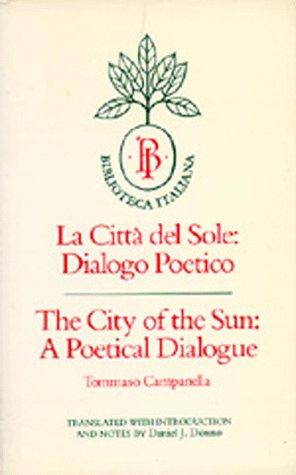
Jacket art via Open Library covers.
Metadata
| Title | La città del sole |
|---|---|
| Author | Tommaso Campanella |
| First published | 1836 |
| Subjects | Utopias, Early works to 1800, Utopies, Poetry (poetic works by one author), Italian literature, History and criticism |
| Known editions | 101 |
| Copyright | Public domain — free to read |
| Open Library work | /works/OL752625W |
Plot & themes
La città del sole is not a novel in the narrative sense but a philosophical dialogue, first written around 1602 while Campanella was imprisoned by Spanish authorities for heresy and conspiracy. It was published in Latin in 1623 and in Italian in 1836 — the Open Library date reflects that later Italian publication, though the work itself is far older.
The premise is simple: a Genoese sea captain recounts to a Grand Master of the Knights Hospitaller what he witnessed during his travels — a perfect society encountered on the island of Taprobane (roughly Sri Lanka). This city, built in concentric rings on a great hill, is governed by a philosopher-priest called the Sun, assisted by three ministers named Power, Wisdom, and Love, each responsible for different aspects of communal life.
The central themes are collective ownership, rational governance, and the harmony of knowledge with virtue. Private property and the family unit are abolished; children are raised by the state and educated through images painted on the city's walls — a kind of visual encyclopedia. Citizens share labor, meals, and even reproduction, which is regulated by magistrates according to astrological and eugenic principles. Religion, philosophy, and science are presented as unified rather than opposed.
The dialogue structure means there is no conventional plot or character development. Instead, Campanella uses the sea captain's report to construct an argument: that human suffering stems from inequality and ignorance, and that a rationally organized community could eliminate both.
How it ends: the dialogue closes with the Grand Master expressing admiration and the sea captain concluding his account. There is no dramatic resolution — the ending is essentially the completion of the description itself, leaving the reader to weigh Campanella's utopian blueprint as a philosophical provocation rather than a story with consequences.
Narrative craft
La città del sole is not a novel in any conventional sense — it is a philosophical dialogue, a form Campanella borrowed from classical and Renaissance tradition. Two speakers carry the entire work: a Grandmaster of the Knights Hospitaller and a Genoese sea captain who has visited the imaginary Sun City. The captain describes what he witnessed; the Grandmaster asks clarifying questions. This framing device keeps the utopian vision at one remove, presented as traveler's testimony rather than authorial decree, which gives it a tone of reported observation rather than prescription.
There is no plot, no timeline of events, and no character development in any narrative sense. The structure is essentially a sustained descriptive inventory — the city's physical layout (concentric rings bearing painted encyclopedic knowledge), its social organization, its laws, its approach to science and religion. The movement is thematic rather than dramatic, proceeding through categories of civic life.
The prose style, in its original Italian and Latin versions, is dense and purposeful, closer to a philosophical treatise than to imaginative fiction. Sentences carry arguments rather than images. Pacing is slow and uniform — there is no acceleration toward climax because there is no dramatic tension to resolve.
The work's most celebrated structural feature is the encyclopedic walls of the city itself, which mirror the text's own organization: knowledge arranged spatially, so that the city is literally a book you can walk through. This recursive idea — a text describing a city that functions as a text — is the central intellectual technique, and it influenced later utopian writing considerably.
A note on date: Open Library gives 1836 as first publication, but the work circulated in manuscript from around 1602 and was first printed in Latin in 1623, making 1836 almost certainly a later edition.
Historical context
A note on the date: Open Library gives 1836, but La città del sole was written around 1602 and first published in Latin in 1623, then in Italian in 1623 as well. The 1836 date almost certainly reflects a later reprint or edition.
Campanella wrote the work while imprisoned in a Neapolitan dungeon, where he would spend roughly twenty-seven years in total after being arrested in 1599 for leading a conspiracy against Spanish rule in Calabria. He escaped execution partly by feigning madness, and it was in this extreme confinement that his most ambitious thinking took shape. The work belongs, then, not to the calm of a scholar's study but to the desperate intellectual energy of a man who had gambled everything on revolution and lost.
The text sits squarely in the Renaissance utopian tradition sparked by Thomas More's Utopia (1516) and shaped further by Francesco Patrizi and other humanists. Campanella was also deeply influenced by natural magic, astrology, and the idea — drawn partly from Ficino and Pico della Mirandola — that human society could be reformed in harmony with cosmic order. His ideal city is governed by a philosopher-priest and organized according to astrological and scientific principles, which places it in dialogue with the new learning of Galileo's generation while remaining rooted in older Hermetic traditions.
The era it describes has no specific historical setting; it is a timeless rational commonwealth reported by a Genoese sea captain, a framing device that deliberately echoes More. The gap between its composition (the age of Spanish imperial dominance and Counter-Reformation repression) and its imagined world is precisely the point: Campanella was dreaming of liberation from inside a cage.
Publication & reception
Campanella wrote La città del sole around 1602, during his long imprisonment in Naples — he had been arrested by Spanish authorities on charges of heresy and conspiracy. The work circulated for decades in manuscript form, a common fate for politically and philosophically dangerous texts in the early modern period.
The first printed edition appeared in Latin (as Civitas Solis) in Frankfurt in 1623, included in a collection of utopian and philosophical writings. An Italian version followed later, but the work remained relatively obscure outside learned circles for much of the seventeenth and eighteenth centuries. The 1836 date recorded by Open Library likely reflects a later Italian edition or collected publication, not the original appearance.
Reception was complicated from the start. Campanella was a Dominican friar writing from a dungeon, and his vision of a sun-worshipping theocratic commune — where property, women, children, and labour are held in common — struck many readers as both dangerously radical and theologically suspect. Catholic authorities had obvious reasons to be uneasy; later readers with socialist sympathies would find it prophetic.
The work attracted serious attention during the nineteenth century, when renewed interest in utopian thought brought Campanella back into intellectual conversation. Thinkers interested in early socialism and communitarian ideals looked to him alongside Thomas More and Francis Bacon as a founding figure of utopian literature.
Commercial success in any modern sense never really applied — this was always a work for scholars and idealists rather than a popular audience. Its reputation rested almost entirely on its historical significance as a bold, strange vision produced under conditions of extreme persecution, which gave it an enduring moral weight beyond its modest literary circulation.
Editions & adaptations
Campanella wrote La città del sole around 1602 while imprisoned by the Spanish Inquisition, but it circulated only in manuscript for decades. It first appeared in print in a Latin version in Frankfurt in 1623, with an Italian version following much later. The work became a foundational text of utopian literature, attracting scholarly editions across Europe and influencing socialist and communist thought, though it has inspired no major screen or stage adaptations of lasting note.
Links open a search on that service.
Influence & legacy
La città del sole (The City of the Sun) left a long shadow over European thought, feeding directly into debates about ideal societies that ran through the seventeenth, eighteenth, and nineteenth centuries. Campanella's vision of a city governed by reason, collective ownership, and scientific education placed him in a lineage stretching from Thomas More's Utopia and helped establish utopian writing as a serious philosophical genre rather than mere fantasy.
Francis Bacon is thought to have been aware of Campanella's ideas when composing New Atlantis, and the two works are frequently paired in scholarly discussions of early modern utopias. Later, thinkers associated with early socialism — including some interpreters of Saint-Simon and Owen — cited Campanella as a forerunner, attracted by his insistence on communal property and the abolition of private family structures.
The work appears regularly on canonical lists of utopian literature alongside More, Bacon, and James Harrington, and it features in university syllabuses devoted to Renaissance political thought and the history of ideas. Scholars of science history also return to it for its portrait of a society organized around natural knowledge, with the city's very walls serving as an encyclopedia of learning — an idea that resonates with later encyclopedic projects.
Its standing today is that of an essential primary text rather than a widely read classic. General readers rarely encounter it independently, but it remains indispensable to historians of political philosophy, Renaissance studies, and the utopian tradition. The Open Library date of 1836 reflects a printed edition rather than the work's true first circulation: the Italian text circulated in manuscript after roughly 1602 and first appeared in Latin print in 1623, a discrepancy worth noting for any researcher tracing its reception history.