Novel dossier
The Mysterious Stranger
✓ Verified against Open Library Analysis by AI — the text discussed, never reproduced
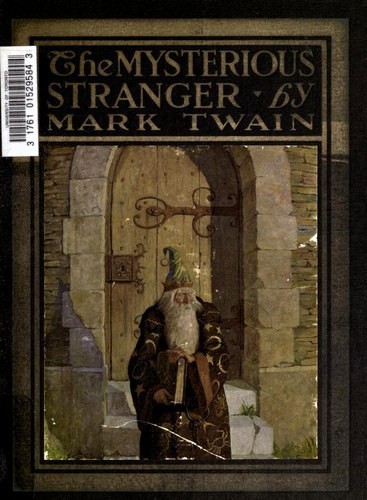
Jacket art via Open Library covers.
Metadata
| Title | The Mysterious Stranger |
|---|---|
| Author | Mark Twain |
| First published | 1916 |
| Subjects | American Humorous stories, Social life and customs, Open Library Staff Picks, Fiction, Manuscripts, Devil |
| Known editions | 82 |
| Copyright | Public domain — free to read |
| Open Library work | /works/OL54158W |
Plot & themes
Set in a small Austrian village in the sixteenth century, The Mysterious Stranger follows three young boys who encounter a captivating, supernatural being who calls himself Satan — a nephew, he claims, of the famous fallen angel. This visitor possesses extraordinary powers: he creates and destroys miniature human worlds on a whim, performs miracles, and sees through the pretensions of human society with cold, amused clarity.
The central consciousness belongs to Theodor Fischer, through whose eyes the reader watches Satan demonstrate both his dazzling abilities and his utter indifference to human suffering. Satan is not cruel in the conventional sense — he simply cannot take human pain seriously, viewing mortals as trivial, self-deceiving creatures trapped by their own moral codes and social fears. The boys are by turns fascinated and disturbed by him.
The novel's major themes include the absurdity of human morality, the cruelty hidden inside respectable society, and the question of free will versus fate. Satan repeatedly shows the boys how intervening to "help" someone often makes their long-term situation worse, undermining any confidence in human judgment or goodness. Twain also targets organized religion and the mob mentality of village life, depicting ordinary people as conformists capable of great injustice when social pressure demands it.
The tone is darkly comic in places but grows progressively bleaker, reflecting Twain's late-life disillusionment with humanity at large.
How it ends: The novel culminates in one of literature's most nihilistic conclusions, when Satan delivers a devastating philosophical speech revealing that life, the universe, and human experience itself may be nothing more than a dream — with no objective reality, no God, and no self that truly exists. It is a wrenching dismissal of everything Theodor believed, leaving the boy utterly unmoored.
Narrative craft
The story is told in the first person by Theodor Fischer, a young boy in a medieval Austrian village. This choice gives the novel an intimate, ground-level perspective on events that grow increasingly strange and philosophically disturbing. The narrator is a witness more than a participant, which lets Twain use him as a lens rather than an agent — the boy observes, wonders, and slowly loses his certainties.
The structure is episodic. Satan, the charismatic stranger of the title, appears and disappears, performing miracles and delivering increasingly dark speeches about humanity's worthlessness. Rather than a tightly plotted arc, the book moves through a series of encounters and demonstrations, each one ratcheting up the nihilism. This loose, accumulative structure suits the material: the point is erosion, not resolution.
A well-known complication is that the novel was never finished in Twain's lifetime and the 1916 version — the one most readers know — was substantially edited by Albert Bigelow Paine and Frederick Duneka. Scholars later established that this published text was assembled and altered from manuscript fragments. The "ending," in which Satan delivers his famous speech declaring existence a dream, was taken from a different manuscript and grafted on. So the structure readers experience is partly editorial construction.
The prose is late-Twain: leaner and more bitter than his earlier work, stripped of much of the humor, though dry irony surfaces occasionally. Pacing is uneven — reflective and slow in the village scenes, then suddenly accelerating when Satan compresses time or destroys lives with offhand ease. That contrast between the boy's plodding ordinary world and Satan's indifferent cosmic speed is itself a technique, making human concerns feel small by sheer narrative rhythm.
Historical context
Mark Twain wrote the stories that became The Mysterious Stranger during the last decade of the nineteenth century and the early years of the twentieth — a period marked by private catastrophe and public disillusionment. His publishing company had gone bankrupt, his daughter Susy had died suddenly, and his wife Livy was in long decline. The genial humorist of the 1870s and 1880s had curdled into something darker and more philosophical.
The book was not published until 1916, six years after Twain's death in 1910, and the version that appeared then was assembled and edited by his literary executor Albert Bigelow Paine — a fact that matters, because scholars later established that Paine had combined and altered manuscript fragments Twain never resolved into a finished work. The 1916 date is therefore the publication year of an editorial construction rather than a completed novel.
The story is set in medieval Austria, a deliberate remove from Twain's own time. That distance gave him license to interrogate Christian belief, institutional cruelty, and human moral cowardice without the friction of direct contemporary satire.
Culturally, the work sits at the intersection of several pressures:
- American imperialism abroad, particularly the Philippine-American War, which Twain publicly opposed
- The erosion of Twain's own religious faith over decades
- A broader late-Victorian crisis of belief following Darwin and the higher criticism of scripture
- European literary pessimism, including the influence of Schopenhauer, which had reached American intellectual circles
The figure of Satan arriving among credulous humans to expose their vanity echoes Voltaire's Candide and anticipates twentieth-century absurdism. Twain was writing, however fitfully, a farewell to the optimism his earlier career had sometimes seemed to endorse.
Publication & reception
Mark Twain died in 1910 leaving behind a tangled mass of manuscripts related to a story about a mysterious angelic visitor named Satan. He had worked on the tale obsessively across multiple versions over the final decade or so of his life, never settling on a finished form. After his death, his literary executor Albert Bigelow Paine, together with editor Frederick Duneka, assembled one of those drafts into a publishable narrative. The result appeared in 1916, six years after Twain's death, under the title The Mysterious Stranger — the 1916 date given by Open Library aligns with this posthumous publication.
The critical reception was largely warm, with many readers and reviewers treating it as a late masterpiece from America's most beloved humorist. Its dark philosophical vision — Satan dispensing a bleak view of human nature and consciousness — struck readers as a fitting, if startling, farewell from a writer whose later years had grown increasingly bitter and skeptical.
However, the publication carried a serious problem that would only come fully to light decades later. Scholars, most notably William M. Gibson in the 1960s, discovered that Paine and Duneka had essentially constructed their published text from an incomplete manuscript draft and had added material — including the famous final paragraph — without disclosing the editorial intervention. This revelation recast the 1916 book as a compromised artifact rather than a pure Twain text.
The University of California Press eventually published a scholarly edition presenting the various manuscript versions separately, allowing readers to engage with what Twain actually wrote. Despite the controversy over its editorial history, the 1916 version remained widely read and anthologized, securing the story's reputation as one of Twain's most haunting and philosophically ambitious works.
Editions & adaptations
The Mysterious Stranger was published posthumously in 1916 by Harper & Brothers in a heavily edited version prepared by Albert Bigelow Paine and Frederick Duneka, later revealed to be significantly altered from Twain's manuscripts. Scholarly controversy over the text's authenticity drove multiple re-editions, culminating in a landmark critical edition in 1969. The tale's dreamlike, philosophical darkness attracted filmmakers, and a 1985 animated adaptation became particularly well known, introducing the story to new generations.
Links open a search on that service.
Influence & legacy
The Mysterious Stranger occupies an unusual place in literary history: it arrived posthumously in 1916, edited and shaped by Twain's literary executor Albert Bigelow Paine, and scholars later discovered that what readers had absorbed for decades was a substantially altered text. The "real" manuscript situation — several unfinished versions — was not fully exposed until 1969, when William M. Gibson's scholarly edition revealed the editorial liberties taken. That revelation itself became influential, prompting wider discussion about authorial intent, posthumous publication ethics, and the role editors play in constructing a literary reputation.
As a work of dark, deterministic philosophy, the book fed into a strand of American pessimism that writers exploring nihilism and the absurdity of human existence would find congenial. Its vision of human history as a parade of cruelty, and its argument that consciousness itself may be a cosmic joke, resonates with strains of existentialist and absurdist fiction that flourished in the mid-twentieth century.
The novel is frequently cited in discussions of Twain's late, bitter period — sometimes called his "dark writings" — alongside What Is Man? and Letters from the Earth. This framing has shaped how scholars understand his career arc, moving the popular image of Twain away from purely comic territory.
In terms of canonical standing, the book appears regularly on reading lists focused on American literary pessimism and on courses examining Twain's full body of work. It is not a mass-market favorite the way Adventures of Huckleberry Finn remains, but among serious readers of Twain it is considered essential for understanding how his worldview darkened in his final years, making it indispensable to his legacy even in its complicated, unfinished form.