Novel dossier
The Time Machine
✓ Verified against Open Library Analysis by AI — the text discussed, never reproduced
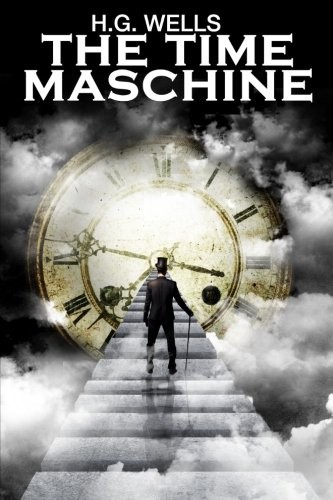
Jacket art via Open Library covers.
Metadata
| Title | The Time Machine |
|---|---|
| Author | H. G. Wells |
| First published | 1895 |
| Subjects | Fiction, Time travel in fiction, Dystopias in fiction, Literature, Scientists, Classic Literature |
| Known editions | 1146 |
| Copyright | Public domain — free to read |
| Open Library work | /works/OL52267W |
Plot & themes
H. G. Wells builds his story around an unnamed Victorian scientist — known simply as the Time Traveller — who has constructed a machine capable of moving through time as freely as a vehicle moves through space. The novel opens in his comfortable English home, where he demonstrates a small model to a gathering of skeptical dinner guests before departing on a journey far into the future.
The bulk of the narrative follows the Time Traveller's arrival in the year 802,701, where he discovers that humanity has split into two distinct species. The Eloi are graceful, childlike, and passive, living in decaying palaces above ground. The Morlock are pale, ape-like creatures who dwell underground, tending machinery in the dark. This stark division anchors the novel's central argument: that class division, left unchecked, produces not progress but mutual degradation. The leisure class loses all vigor; the laboring class loses all humanity.
The themes reach further than class commentary. Wells explores entropy — the idea that even civilizations and suns run down — and challenges the Victorian confidence in inevitable progress. The Time Traveller is driven by scientific curiosity but also by an urgent practical problem: his machine has gone missing, and he must recover it before he is stranded.
Wells also uses the Eloi and Morlock to examine the relationship between comfort and intelligence, between fear and power, and between surface appearances and hidden realities.
How it ends: The Time Traveller escapes the far future and returns to the present, shaken by what he has witnessed. He departs on a second journey and never comes back, leaving his dinner guests — and the reader — with only the account he left behind, and two strange flowers as silent evidence of a future no one else has seen.
Narrative craft
The Time Machine uses a layered, frame-narrative structure. An unnamed narrator recounts an evening dinner party at which the Time Traveller — himself never given a proper name — describes his extraordinary journey to the far future. That inner story is delivered largely in the Traveller's own voice, so readers experience a story-within-a-story, one step removed from the events themselves. This distancing is deliberate: it keeps the fantastic elements at arm's length, lending them a kind of cautious plausibility.
The novel is short — closer to a novella — and moves briskly. Wells wastes little time on the mechanics of time travel itself, pushing the Traveller quickly into the strange society of the Eloi and the Morlocks. Once there, the pacing slows just enough for the Traveller to observe, theorise, and revise his theories as he learns more unsettling truths.
The prose is plain and functional rather than ornate. Wells writes in a lecturing, speculative register — the voice of a late-Victorian man of science thinking out loud. Sentences tend to be direct and explanatory, more interested in ideas than in sensory richness.
A few notable craft features:
- The unreliable transmission of the tale: the outer narrator admits he cannot be sure of every detail, quietly signalling the story's constructed, secondhand nature.
- Wells uses the Traveller's evolving hypotheses — first wrong, then corrected — as a structural motor, giving the middle section genuine narrative tension.
- The novel ends with genuine ambiguity about what happened to the Traveller, and the outer narrator reflects on it in a quietly elegiac closing passage that lifts the whole story toward something more philosophically mournful than a simple adventure.
Historical context
H. G. Wells published The Time Machine in 1895, when he was twenty-eight years old and still an unknown quantity in the literary world. It was his first full-length novel, and it launched his career almost immediately. Within a few years he would be celebrated alongside Jules Verne as a founding figure of what we now call science fiction, but at this moment he was a former scholarship student from a working-class background, recently married, scraping by on journalism and teaching.
The novel grew out of a series of earlier sketches Wells had written in the late 1880s under the title "The Chronic Argonauts," revised and sharpened considerably before reaching its published form. The 1895 date is accurate and undisputed.
The era Wells was writing in matters enormously. Victorian Britain was preoccupied with Darwin's theory of evolution, published in 1859, and with the social question of class — whether the widening gap between industrial capitalists and the urban poor was sustainable. Wells had absorbed both anxieties. The novel projects them forward by hundreds of thousands of years, imagining a future England in which the class divide has literally speciated humanity into two distinct and degraded races.
The era the story is set in reaches as far as the year 802,701 — a gulf of nearly eight centuries chosen to make evolutionary change plausible. That enormous span separates the book from the gentler future-speculation common in Victorian utopian fiction and gives Wells's vision its particular bleakness.
The novel was also answering the optimistic progressivism fashionable in the 1890s — the confident belief that science and industry were steering humanity toward inevitable improvement. Wells, shaped by his own precarious social position, was deeply skeptical of that confidence, and The Time Machine is in large part a calculated argument against it.
Publication & reception
The Time Machine began its life not as a book but as a serial. Wells reworked an earlier piece called "The Chronic Argonauts," published in his college magazine in 1888, extensively revising and reimagining it over several years. The story ran in the New Review in 1895 before Heinemann published it as a standalone volume that same year, making it Wells's first full-length published novel.
The reception was immediate and enthusiastic. Reviewers recognized something genuinely new in Wells's blend of scientific speculation and social commentary. Critics praised the vividness of the far-future landscapes and the underlying critique of class division, which gave the story intellectual weight beyond mere adventure. The book sold well from the outset and went through multiple printings quickly, establishing Wells as a significant new voice in British fiction.
No major literary prizes existed in Britain at the time to mark such a debut, but the cultural impact was notable. The novella's brevity — it runs only around 90 pages — made it accessible, and its central conceit captured the public imagination in a way that longer, more demanding works often failed to do.
The book's commercial fortunes only improved with time. It never went out of print and was taken up by publishers on both sides of the Atlantic throughout the late nineteenth and early twentieth centuries. Its success gave Wells the confidence and the financial footing to continue producing scientific romances, leading directly to The Island of Doctor Moreau and The War of the Worlds within a few years. In retrospect, the novel's 1895 publication is widely regarded as a founding moment in modern science fiction.
Editions & adaptations
H. G. Wells's The Time Machine has enjoyed remarkable longevity since its 1895 debut, passing through countless printings and inspiring multiple screen and stage interpretations. The novella's vivid imagery of a far-future Earth divided between the Eloi and Morlocks proved irresistible to filmmakers and broadcasters across the twentieth century. It remains a staple of science-fiction curricula and popular culture, its central conceit of a machine enabling deliberate temporal travel becoming one of literature's most enduring ideas.
Links open a search on that service.
Influence & legacy
The Time Machine essentially invented the vocabulary of time travel as we now understand it. Before Wells, fictional journeys through time relied on dreams, magic, or divine intervention. Wells gave the world a machine — a device built by human ingenuity — and the phrase "time machine" itself passed so completely into everyday language that most people who use it have never read the book.
Its influence on science fiction is foundational in a way few novels can claim. Writers from H. G. Wells's own generation onward had to reckon with what he had done. Isaac Asimov, Arthur C. Clarke, and Ray Bradbury all acknowledged debts to Wells broadly, and the novel's core conceits — a far-future humanity split into contrasting castes, entropy overtaking civilization, the traveler as horrified witness — echo through countless later works. Bradbury's own time-travel stories owe their moral seriousness in part to the template Wells established.
The novel's dystopian vision also fed into a separate tradition. The Eloi and Morlock divide, leisure class preyed upon by a laboring underclass, influenced later social-fiction writers thinking about class and technology, including elements visible in Aldous Huxley and George Orwell's satirical futures.
On canonical lists the novel appears reliably among the foundational texts of science fiction — the Science Fiction Writers of America and similar bodies consistently treat it as a progenitor of the genre rather than merely an early example of it.
Today it remains in print in dozens of editions, regularly assigned in universities under both literature and science fiction courses. Film and television adaptations, most notably in 1960 and 2002, have kept it visible to audiences who may never open the book. Its standing is secure: short, propulsive, and philosophically unsettling, it has outlasted almost everything written in the same decade.