Novel dossier
The Virgin and the Gypsy
✓ Verified against Open Library Analysis by AI — the text discussed, never reproduced
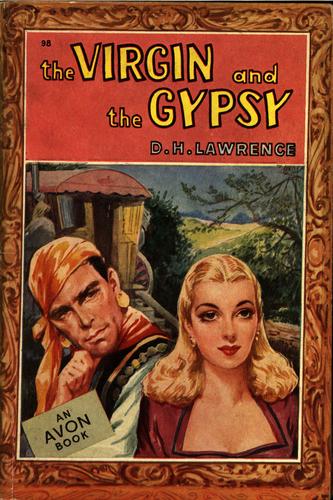
Jacket art via Open Library covers.
Metadata
| Title | The Virgin and the Gypsy |
|---|---|
| Author | D. H. Lawrence |
| First published | 1930 |
| Subjects | Fiction, Novellas, Relationships, Prejudice in fiction, Romanies, Women |
| Known editions | 15 |
| Open Library work | /works/OL81237W |
Plot & themes
The Virgin and the Gypsy centers on Yvette Saywell, a young Englishwoman returning home after time at school, who finds herself stifled by the suffocating respectability of her family's rectory household. Her father is a vicar, emotionally cold and self-righteous; the household is dominated by his mother, a tyrannical, manipulative old woman the family calls "the Mater," whose pious authority smothers any spontaneous feeling or genuine life.
Into this atmosphere of repression rides Joe Ferenczi, a Romani gypsy whom Yvette encounters on the road. He is darkly vital, self-possessed, and entirely outside the social world that constrains her. She is drawn to him with a force she cannot fully explain or act on — partly desire, partly a hunger for the aliveness he represents.
The novella's central thematic argument is the opposition between dead social forms and genuine human vitality. Lawrence sets the dead weight of English provincial respectability — embodied in the Mater and the vicar's household — against the instinctive, natural energy the gypsy represents. Yvette is caught between these forces, aware that conventional life is slowly killing something in her but uncertain how to escape it.
Class, sexuality, and the hypocrisy beneath religious virtue are all threaded through the novella. Lawrence is also interested in the particular vulnerability of women in early twentieth-century England, whose emotional and sexual lives were tightly policed by exactly the kind of household Yvette inhabits.
How it ends: A catastrophic flood strikes the area, destroying much of the rectory. The gypsy saves Yvette's life, sheltering her through the night in intimate physical closeness. The Mater perishes in the flood. Yvette survives, irrevocably changed by the encounter, though the gypsy disappears afterward, leaving only a brief letter. The ending is deliberately ambiguous — liberation and loss arrive together, and what Yvette does with her new freedom remains unresolved.
Narrative craft
Lawrence narrates the story in close third person, staying tightly focused on Yvette, the young protagonist. The reader experiences the world almost entirely through her perceptions, longings, and confusions, yet the narrator maintains enough ironic distance to see around her blind spots — a technique Lawrence uses to show both her vitality and her immaturity simultaneously.
The novella is compact and essentially linear, moving through a single season with a clear dramatic arc. There are no numbered parts or chapter breaks in the conventional sense; the narrative flows in continuous sections, building toward the climactic flood that ends the story. That flood functions as both literal catastrophe and symbolic release, a structural device Lawrence clearly shapes with intention.
The prose style is characteristic Lawrence: sensory, rhythmic, and emotionally charged without being ornate. Descriptions of landscape carry psychological weight — the cold, repressive rectory and the open countryside register as moral states as much as physical settings. Sentences vary between short declarative statements and longer, winding ones that follow the drift of feeling.
Pacing is notably uneven in ways that feel deliberate:
- The early sections move slowly, accumulating domestic atmosphere and social constraint
- The arrival of the gypsy Joe Boswell accelerates the emotional tempo sharply
- The flood sequence moves with sudden, almost violent speed
The novella was published posthumously in 1930, a year after Lawrence's death, and some scholars note it reads as a finished but slightly unrevised work — the abrupt ending in particular has attracted critical debate about whether Lawrence intended to develop it further. That rawness, however, gives the narrative a concentrated, urgent quality that a more polished draft might have softened.
Historical context
Lawrence wrote The Virgin and the Gypsy in 1926, near the end of his life, though it was published posthumously in 1930, the same year he died. By that point he had already completed Lady Chatterley's Lover, and the novella shares that book's preoccupations: class rigidity, sexual repression, and the deadening effect of respectable English society on the human spirit.
The story is set in the English Midlands in the early 1920s, a period Lawrence knew intimately from his own working-class Nottinghamshire upbringing. He wrote it while living abroad — largely in Italy and the American Southwest — an exile that gave him a cold, clear distance from the England he was dissecting. The gap between writer and subject sharpens the portrait considerably.
The surrounding culture matters here. Post-war England was navigating profound social anxiety: the old class structures had been shaken by the First World War, women had recently gained partial suffrage, and yet provincial life clung fiercely to Victorian moral codes. Lawrence was answering that rigidity directly. The Romany figure — free-moving, outside respectability's reach — served a symbolic function that was well-established in Romantic literature, but Lawrence gave it erotic and psychological urgency that felt contemporary and deliberately provocative.
The novella also reflects the period's contested attitudes toward Romani people. Lawrence uses the gypsy character more as a catalyst for the young English woman's awakening than as a fully realized figure in his own right, which sits uneasily for modern readers but accurately mirrors how mainstream Edwardian and early Georgian culture perceived and aestheticized Romani life — as exotic, threatening, and irresistibly outside convention.
Publication & reception
D. H. Lawrence completed The Virgin and the Gypsy around 1926, but like several of his later works it was withheld from publication during his lifetime. Lawrence died in March 1930, and the novella appeared posthumously later that same year, issued by the Florence-based private press of Giuseppe Orioli — the same publisher who had handled the controversial Lady Chatterley's Lover in 1928. Orioli produced a limited edition, keeping the publication outside the mainstream British and American markets that Lawrence had frequently clashed with over censorship.
Critical reception was broadly warm. Reviewers recognized in the novella many of Lawrence's characteristic preoccupations — vitality set against emotional deadness, the claims of instinct against those of convention — but found the shorter form more controlled and accessible than some of his larger, more embattled novels. The work did not carry the same censorship lightning rod as Lady Chatterley, and this relative freedom allowed critics to engage with its literary qualities more straightforwardly.
Commercially, the limited posthumous edition meant initial circulation was narrow. Wider readership came later, as mainstream publishers brought out more accessible editions through the 1930s and beyond. The novella gradually secured a modest but steady place in Lawrence's canon — not among his most discussed works, yet reliably reprinted as part of collected editions and taught in university courses as an example of his compressed, late style.
No major prizes attached to it, which is unsurprising given both its posthumous status and the literary-prize landscape of the early 1930s. Its reputation has grown quietly over the decades, appreciated particularly by readers and scholars who find the brevity clarifying rather than limiting.
Editions & adaptations
The Virgin and the Gypsy was published posthumously in 1930, a year after Lawrence's death, and quickly established itself as one of his most accessible shorter works. It has attracted a steady stream of scholarly editions and general reprints, and its charged central relationship made it a natural candidate for screen adaptation. The 1970 British film brought the novella its widest popular audience, while the text itself has been reprinted in numerous collected Lawrence volumes and standalone paperback editions worldwide.
Links open a search on that service.
Influence & legacy
The Virgin and the Gypsy holds a curious place in Lawrence's legacy: published posthumously in 1930, shortly after his death, it arrived already trailing the controversial reputation of Lady Chatterley's Lover and was received as a companion piece to that novel's themes of sexual awakening and class transgression. Critics and readers who found Lady Chatterley too explicit often pointed to this shorter work as a more accessible distillation of the same preoccupations.
Lawrence scholars have consistently treated the novella as a key text for understanding his recurring interest in vitality set against repression — the life force embodied in an outsider figure confronting the deadening proprieties of English provincial life. It appears regularly on university syllabi as an introduction to Lawrence, its relative brevity making it more teachable than the longer novels.
The 1970 film adaptation, directed by Christopher Miles and starring Joanna Shimkus and Franco Nero, brought the story to a wider audience and gave it a second cultural moment during a period of renewed Lawrence interest.
Its standing today is that of a respected secondary work — admired by enthusiasts, studied seriously in academic contexts, but not commanding the same popular recognition as Sons and Lovers or Women in Love. It tends to appear on curated reading lists devoted specifically to Lawrence rather than on broader lists of essential British fiction.
Among Lawrence's influence on later writers, the novella contributes to a strain of British fiction exploring female consciousness and the collision between respectable society and dangerous outsiders — a territory that writers from Daphne du Maurier onward would inhabit, though direct lines of influence are difficult to establish with certainty.