Novel dossier
The Triple Echo
✓ Verified against Open Library Analysis by AI — the text discussed, never reproduced
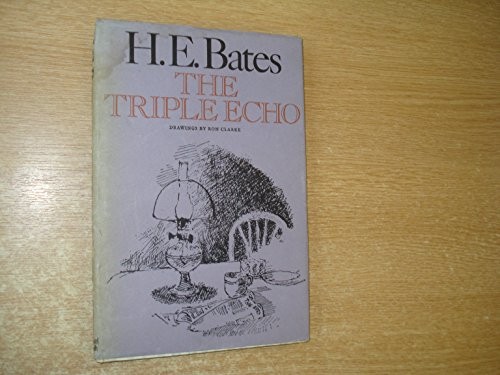
Jacket art via Open Library covers.
Metadata
| Title | The Triple Echo |
|---|---|
| Author | H. E. Bates |
| First published | 1970 |
| Subjects | Fiction, English fiction, Country Life, Deserters, Relationships, English literature |
| Known editions | 3 |
| Open Library work | /works/OL163694W |
Plot & themes
Set in the English countryside during the Second World War, The Triple Echo follows a solitary farmer's wife, Barton, whose husband is a prisoner of war somewhere abroad. Her isolation is broken when a young British soldier named Barton — the two sharing a surname is a small irony Bates exploits — deserts and takes refuge on her farm. The two become lovers, and the woman, protective of him, devises a scheme to conceal his presence: she dresses him as a woman, gradually reshaping his identity until he passes convincingly as her sister.
The novel's central tension is this slow erosion of the soldier's selfhood. What begins as a practical disguise becomes something stranger and more psychologically loaded, as the young man sinks deeper into the feminine role, losing his grip on who he was. Bates is interested in the way isolation, desire, and fear can remake a person, and the rural setting — quiet, cut off, governed by its own rhythms — amplifies that claustrophobia.
The themes running through the book include:
- The costs of desertion, both legal and psychological
- Gender identity and the malleability of the self under pressure
- Wartime loneliness and the desperate bargains people make for connection
- The tension between protection and possession in a love affair
Bates keeps the prose spare and the world narrow, which suits a story about two people trying to disappear inside a fiction they have made together.
How it ends: The disguise eventually collapses when a bullying army sergeant, suspicious and predatory, forces his way into their world. His discovery of the truth triggers a violent confrontation, and the soldier is killed — the three-way encounter that gives the novel its title resolving in tragedy, leaving Barton alone again, the brief shelter of their shared life destroyed.
Narrative craft
The Triple Echo is told in close third-person, following a lonely farmer's wife during the Second World War after she shelters a British army deserter on her remote rural property. The narration stays tightly bound to immediate experience — landscape, sensation, the texture of daily work — rather than ranging outward into history or commentary. Bates keeps the camera low and close, almost cinematically, which suits the material: this is a story about concealment, and the prose itself feels watchful.
The novel is short, closer to a novella than a full-length book, and its brevity is structural rather than incidental. There are no wasted scenes. Bates builds tension through accumulation of domestic detail rather than dramatic confrontation, so that when danger finally arrives it feels inevitable rather than sudden.
Pacing is deliberate and unhurried in the early sections, mimicking the rhythms of isolated country life — seasons changing, chores repeating, the couple settling into an uneasy domestic routine. The tempo tightens considerably in the later movement, where the presence of an outside threat compresses time and forces decisions.
The prose style is spare and concrete. Bates, a noted craftsman of the English short story, writes sentences that stay close to the physical world — weather, animals, earth, the body. He avoids abstraction and sentiment, which makes the emotional weight land harder precisely because it is underplayed.
The novel is also known for its central structural conceit: the deserter disguises himself as a woman to avoid detection, a device that allows Bates to explore identity, performance, and vulnerability with considerable economy. This premise generates much of the story's psychological tension without requiring explicit analysis — the situation speaks for itself.
Historical context
H. E. Bates published The Triple Echo in 1970, when he was in his mid-sixties and well into the most commercially successful phase of his career. The Darling Buds of May had made him a household name in Britain during the 1950s, and by 1970 he was a respected, prolific figure in English letters — someone who had moved fluidly between short fiction, novels, and war writing across four decades.
The novel is set during the Second World War, meaning Bates was looking back roughly a quarter-century to write it. This gap matters. He had direct experience of wartime Britain, having served as an RAF writer producing fiction and reportage under the pen name Flying Officer X. That intimacy with the period gave him material he could revisit with the cooler eye of distance.
The story concerns a soldier who deserts and hides on a farm, disguising himself as a woman — a premise that sits at the intersection of several pressures visible in culture around 1970:
- The late 1960s had brought a renewed frankness about sexuality and gender in British fiction and film, and Bates was engaging, in his restrained way, with that opening.
- Desertion and the costs of military conformity were live topics, sharpened by the ongoing Vietnam War and a generation questioning martial obligation.
- Rural England as a place of refuge and moral complexity was ground Bates had worked all his life, rooted in his deep feeling for the Midlands and countryside.
The novella's brevity — it runs short — suits its intensity. It was successfully adapted as a British film in 1972, suggesting it caught something the moment was ready to receive.
Publication & reception
H. E. Bates published The Triple Echo in 1970 through Michael Joseph, the London house that had long been his primary British publisher. The novella was relatively brief even by Bates's standards, running to under a hundred pages, and it emerged during a period when he was still producing fiction at a steady rate despite being in his mid-sixties.
Critical reception was warm rather than thunderous. Reviewers recognised the tight, spare construction as characteristic of Bates at his most disciplined, and the wartime rural setting — a lonely farm, a soldier in hiding, a woman keeping her own counsel — drew comparisons to his earlier pastoral fiction. The subject of desertion, treated without easy moral judgment, was noted as quietly daring for a writer of his generation.
The book found a considerably wider audience when it was adapted for film in 1972, directed by Michael Apted and starring Glenda Jackson and Brian Deacon. The film's modest but respectable reception drew renewed attention to the novella itself, and the two works circulated together in the public consciousness for some years afterward. A film tie-in edition helped extend the book's commercial life beyond what a slender literary novella might ordinarily expect.
No major prizes are recorded for the novel, and it attracted no significant controversy. Its reputation settled into that of a accomplished minor work by a major writer — admired by Bates enthusiasts and by readers who came to it through the film, but not widely taught or held up as a landmark. It stands as a clear demonstration of Bates's gift for compression and atmospheric tension, appreciated steadily rather than celebrated loudly.
Editions & adaptations
The Triple Echo had a modest but meaningful afterlife following its 1970 first publication by Michael Joseph. Its most significant extension beyond the printed page was a well-regarded British film adaptation released in 1972, which brought the novel wider public attention. The book was subsequently reissued in paperback editions that kept it in circulation. Bates's spare, tension-filled novella has remained a recognized minor classic of rural wartime fiction within the H. E. Bates canon.
Links open a search on that service.
Influence & legacy
The Triple Echo occupies a modest but secure place in Bates's late career, regarded by many critics as among his finest short novels and a demonstration that his gift for compressed rural fiction remained sharp well into the 1970s. It did not launch a school of writing or generate a cluster of imitators, but its influence worked more quietly, reinforcing a tradition of British rural fiction in which landscape and moral atmosphere are inseparable.
The 1972 film adaptation, directed by Michael Apted and starring Glenda Jackson and Oliver Reed, gave the story a visibility it might not otherwise have sustained. Films based on literary works often outlast the books in public memory, and this is partly true here: many readers came to the novel after encountering the film rather than the other way around.
Bates himself was already a canonical figure in British short fiction, and The Triple Echo is frequently cited alongside his Larkin stories as evidence of his range. It appears on reading lists concerned with mid-twentieth-century English rural writing and with the literature of the Second World War's home-front experience.
Its standing today is that of a respected, teachable text rather than a widely read popular novel. It tends to attract readers who have already discovered Bates elsewhere and want to see what he could do at novella length with darker, more psychologically pressured material. Specialist literary surveys of the period acknowledge it as proof that brief fiction can carry genuine weight — a point Bates made repeatedly throughout his career and that The Triple Echo makes quietly but firmly on its own terms.