Song dossier
Walk On By
✓ Verified against MusicBrainz Analysis by AI — lyrics discussed, never reproduced
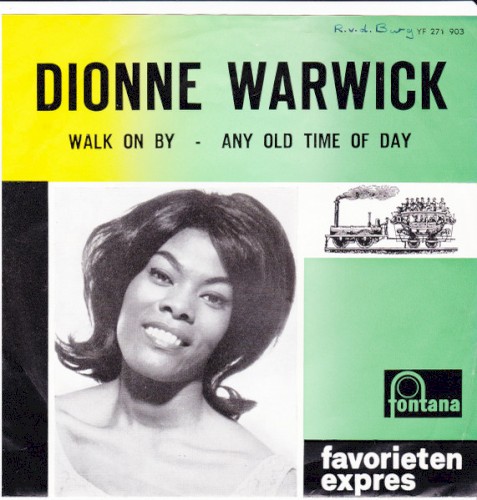
Sleeve art via the Cover Art Archive.
Metadata
| Title | Walk On By |
|---|---|
| Artist | Dionne Warwick |
| First released | 1964 |
| Written by | Burt Bacharach, Hal David |
| Length | 2:58 |
| Work | Walk On By |
| MusicBrainz recording | 12fa7621-8e59-44e9-b29a-bcb260f6b80d |
Lyrical themes
The song is a quiet study in public heartbreak. The narrator addresses a lover who has ended the relationship, pleading with him not to stop when he sees her on the street — not out of coldness, but because she cannot hold herself together in his presence. Every glimpse of him threatens to undo her composure entirely, and she would rather vanish from his sight than let him witness her falling apart.
Hal David's lyric is built around a single, recurring act of self-protection. The narrator is not angry or accusatory; she is exhausted by grief and desperate to preserve what little dignity remains to her. The emotional register is one of restrained anguish — she is barely keeping it together, and the song's entire architecture is a sustained effort not to crack.
What gives the lyric its particular power is the tension between public space and private feeling. The street becomes a kind of stage on which she fears exposure. The imagery is minimal — a glance, a wave, tears that arrive without warning — but that minimalism amplifies the vulnerability. Every ordinary encounter carries the threat of collapse.
The point of view is intimate and confessional despite being addressed directly to the ex-lover, which means the listener effectively overhears a private plea. This creates an unusual closeness: Warwick seems to be confiding in us even as she speaks to him.
Burt Bacharach and Hal David have discussed the song as a straightforward portrait of heartbreak told from a woman's perspective, with no hidden allegory intended. Its lasting resonance comes from how precisely it captures something most people recognize: the particular agony of loving someone you still have to share the world with.
Song structure
"Walk On By" opens with one of the most immediately recognizable intros in pop history: a four-bar figure in which a muted trumpet plays a descending, melancholic phrase over a gentle bossa nova-inflected rhythm. That handful of bars sets the emotional temperature before Warwick has sung a note.
The song follows a verse-chorus structure repeated with careful escalation. The verses carry the narrative weight — a quietly devastating story told in a conversational, almost private tone — while the chorus (built around the title phrase) delivers the emotional gut-punch. There is no traditional bridge; the arrangement achieves contrast through orchestral and dynamic swells rather than a distinct new section.
What makes the structure remarkable is how Bacharach and arranger Burt Bacharach — working as both composer and arranger — build intensity through accumulation rather than radical change. Strings enter and thicken as the song progresses. The horn section grows more prominent. By the final repeated chorus the full orchestra is present, yet the arrangement never overwhelms Warwick's voice; it rises beneath her like a tide.
The dynamics follow an arc from intimate to expansive. The opening feels almost whispered, and Warwick's phrasing reinforces that sense of controlled grief. The memorable moment most listeners lock onto lands at the first chorus return, when the melody lifts and the muted trumpet reappears as a kind of Greek chorus commenting on the lyric's request.
The outro dissolves rather than concludes — the title phrase is repeated, the orchestra gradually pulls back, and the track fades, leaving the impression of someone continuing to walk, unseen. At under three minutes the song is a masterclass in compression: every structural element earns its place, and nothing overstays.
Musical composition
Walk On By sits in a minor key, giving it a brooding, inward quality unusual for a pop hit of its era. The tempo is slow and deliberate — a measured ballad pulse that never rushes, letting the weight of each phrase land fully. Burt Bacharach and Hal David had by 1964 developed a sophisticated harmonic language that sits somewhere between Tin Pan Alley sophistication and modal jazz influence, and this song is a prime example: the chord progressions move through unexpected turns, avoiding the obvious resolutions a simpler songwriter would reach for, creating an emotional ambiguity that suits the lyric's mixture of dignity and barely suppressed grief.
The melody is one of Bacharach's most distinctive — it doesn't flow in smooth arches but moves in short, clipped phrases with unexpected rhythmic placements, as if the narrator is composing herself, catching her breath. Warwick's voice, with its churchgoing warmth and precise intonation, suits this perfectly: she can hold a note with intensity without tipping into melodrama.
The production, handled by Bacharach himself with the Scepter Records team in New York, has a rich, slightly dark orchestral palette. Strings carry much of the harmonic weight, while the rhythm section is restrained — the bass and drums provide a gentle pulse rather than a propulsive beat. A flute line weaves through the texture, adding a fragile, almost questioning quality. The overall sound is lush but controlled, spacious rather than cluttered — Bacharach was already thinking orchestrally in ways that went well beyond standard pop arranging of the period.
The recording became a template: dozens of artists covered it over the following decades, including Isaac Hayes, whose 1969 version stretched it into an epic entirely different in character. Warwick's original remains the definitive statement.
Historical context
"Walk On By" arrived at a pivotal moment in Dionne Warwick's early career. She had only broken through in 1962 with "Don't Make Me Over," and by 1964 she was still establishing herself as a recording artist. The song became the record that truly defined her, cementing the partnership with Burt Bacharach and Hal David that would shape the rest of the decade for all three of them.
The early 1960s pop landscape was in genuine flux. The British Invasion, led by the Beatles, was reshaping American charts and tastes almost in real time — the Beatles had landed in February 1964, just weeks before "Walk On By" was recorded and released. Against that backdrop, the Bacharach-David sound represented a distinctly American sophistication, rooted in orchestrated pop and the Brill Building tradition, offering something more emotionally layered than the beat-group boom from across the Atlantic.
The record was a major commercial success. It climbed to number six on the Billboard Hot 100, making it one of Warwick's biggest hits to that point, and performed even more strongly on the R&B charts. In the United Kingdom it also charted well, demonstrating that Warwick's appeal crossed the Atlantic in both directions during a moment when American acts were having to fight harder for that attention.
Critical reception recognized something special in the arrangement's restraint and Warwick's controlled emotional delivery. Rather than the full-throated belting fashionable at the time, she conveyed heartbreak through a kind of composed vulnerability that reviewers found arresting. The song quickly became a signature, the piece most closely associated with her name, and it launched a run of Bacharach-David hits that would keep Warwick near the top of popular music for the rest of the 1960s.
On screen
Dionne Warwick's original 1964 recording has enjoyed a long life on screen, its melancholy grandeur making it irresistible to filmmakers reaching for a particular shade of heartbreak or urban loneliness.
One of its most celebrated placements came in the 1994 British film "Four Weddings and a Funeral," where the song underscored an emotionally loaded scene with considerable effect, cementing its association with bittersweet romantic feeling for a new generation of listeners.
The song turned up in "Beavis and Butt-Head Do America" (1996), used in a way that played knowingly against its emotional weight — a contrast that has made the placement memorable to fans of both the film and the original recording.
On television, the song has appeared in "Mad Men," the AMC period drama set in the 1960s advertising world, where its era-appropriate atmosphere made it a natural fit. The show's music supervisors were notably careful about period accuracy, and Warwick's recording sat comfortably within that framework.
It also featured in a notable sequence in the BBC series "Life on Mars" (2006–2007), which was set in the early 1970s and leaned heavily on the pop music of the era just preceding its setting.
In advertising, the track's combination of sophistication and emotional directness has made it attractive to brands seeking a knowing, slightly nostalgic tone, though specific verified campaigns are harder to pin down with confidence than its film and television appearances.
The song's screen longevity owes much to its original production — Bacharach's orchestration gives it a cinematic scale that needs little adjustment to sit comfortably within a dramatic context, almost as if it were composed with a scene already in mind.
Covers & hits
Few songs have proven as enduringly versatile as 'Walk On By.' Burt Bacharach and Hal David's sophisticated pop construction has attracted artists across genres for six decades, from soul and jazz to disco and hip-hop. It became a standard almost immediately after Dionne Warwick's hit, inspiring interpretations that range from lush orchestral readings to stark electronic reimaginings. Several covers became significant hits in their own right, and the song's chord changes have made it a favorite reference point for producers sampling classic soul.



Previews and buy links via the iTunes Search API; other links open a search on that service.
Influence & legacy
"Walk On By" arrived at a moment when pop songwriting was being reimagined as an art form, and it helped accelerate that shift. Burt Bacharach and Hal David's combination of unexpected harmonic turns, a stop-start rhythmic structure, and genuinely adult emotional content gave the song an influence that stretched far beyond Warwick's own career.
The track has been covered hundreds of times. Isaac Hayes recorded a famously expanded version in 1969 that stretched the song into a slow-burning, orchestrated epic running close to twelve minutes — a landmark of soul and an early blueprint for what would become funk and disco production. Strangford Amplifires, Average White Band, and later Sybil all returned to it, each finding something different inside its architecture.
In hip-hop and electronic music, "Walk On By" became a favoured source for sampling. Its strings and melodic hooks were lifted by producers across multiple decades, appearing in tracks by artists including EPMD and various underground rap acts, making it one of the more sampled recordings of the Bacharach-David catalogue.
On canonical lists, the song sits near the top by any measure. Rolling Stone has ranked it among the greatest songs ever recorded. It appears on numerous all-time lists compiled by critics and musicians alike, consistently placed as a defining document of 1960s pop.
The Recording Industry Association of America has recognised Warwick's original among the Songs of the Century, cementing its status in the official American cultural record.
Today the song is taught in music schools as a study in sophisticated chord movement and emotional restraint. It remains a standard, performed regularly across genres, and its opening bars are recognisable to listeners who may never have consciously sought it out — the quiet definition of a true classic.