Song dossier
The Last Time I Saw Her
✓ Verified against MusicBrainz Analysis by AI — lyrics discussed, never reproduced
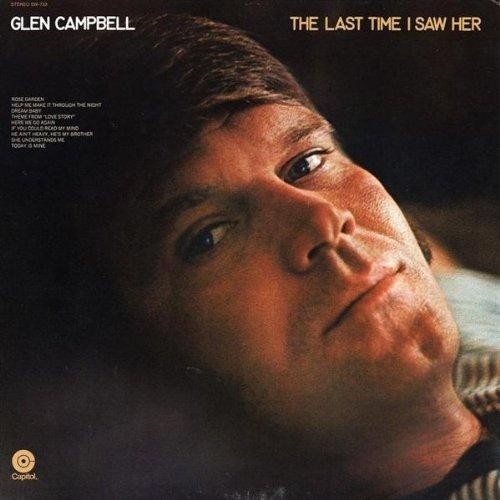
Sleeve art via the Cover Art Archive.
Metadata
| Title | The Last Time I Saw Her |
|---|---|
| Artist | Glen Campbell |
| First released | 1971-07 |
| Written by | Gordon Lightfoot |
| Length | 4:07 |
| Work | The Last Time I Saw Her |
| MusicBrainz recording | e4996e24-b9ff-4e42-98c1-d7d4f4cc31f1 |
Lyrical themes
"The Last Time I Saw Her" is a song of romantic mourning, centered on the ache of a relationship that has ended and the impossible task of letting go. Gordon Lightfoot, writing in the confessional folk tradition he made his own, frames the narrator's experience around a single haunting image: the memory of a final encounter with a woman, crystallized and replayed in the mind. The song does not recount a dramatic break-up scene so much as dwell in its aftermath — the quiet devastation of ordinary memory suddenly loaded with unbearable significance.
The emotional register is restrained and elegiac. Lightfoot favors understatement over outpouring, and the narrator's grief surfaces through detail and recollection rather than direct declaration. The perspective is retrospective throughout; we are always looking back, never in the moment of parting itself. This distance gives the song its particular melancholy — loss is being processed rather than experienced raw.
The narrative arc moves from recollection toward a kind of resigned acceptance that never quite arrives. The narrator circles the memory rather than resolving it, which mirrors the psychological reality of grief: the mind returning again and again to the last image of someone loved. There is tenderness in the narrator's gaze, no bitterness toward the woman, only a sense of incompleteness.
Glen Campbell's recording, released in 1971, suited his gift for wringing quiet emotion from country-pop balladry. His delivery leans into the song's gentleness, giving Lightfoot's introspective lyric a warm, unhurried feeling. Campbell had a strong affinity for material by reflective singer-songwriters — he had earlier recorded Lightfoot's "Early Morning Rain" — and this song fits naturally into that lineage of beautifully crafted, inward-looking laments.
Song structure
Glen Campbell's recording of this Gordon Lightfoot composition follows a fairly traditional verse-chorus structure, moving through several cycles of the two main sections before closing quietly. The song opens with a gentle, unhurried instrumental introduction that establishes the reflective mood immediately — strings and acoustic guitar set a warm, melancholic tone before Campbell's vocal enters.
From there the song moves through verses that carry the narrative weight, each one adding emotional detail to the story of loss and memory. The chorus arrives as a gentle emotional release rather than a dramatic climax, returning the ear to the central image suggested by the title. The arrangement never pushes into bombast; this is a song built on understatement.
As the song progresses through its verse-chorus cycles, the orchestration gradually fills in around Campbell's voice — strings swell slightly, and the overall texture becomes a little richer — but the dynamic range remains narrow. The peak of intensity arrives roughly two-thirds through, where the accumulated weight of the lyric and a fuller arrangement briefly lift the song before it eases back down.
There is no bridge in the traditional sense; Lightfoot's construction relies on the verses doing all the narrative work, with the chorus offering periodic emotional punctuation rather than dramatic contrast.
The outro mirrors the intro's quietness, the arrangement thinning back toward sparse accompaniment and the song fading or resolving gently. The most memorable moment for most listeners is simply Campbell's vocal tone through the central choruses — warm, controlled, and carrying just enough sadness without tipping into sentimentality. It is a song whose structure serves the feeling rather than showing off, which is characteristic of Lightfoot's songwriting craft.
Musical composition
Gordon Lightfoot wrote this song as a quietly aching piece in a major key that nonetheless carries a persistent undertow of melancholy — the harmonic language stays diatonic and clean, moving through the kinds of gentle, expected chord changes that Lightfoot favoured in his early-seventies country-folk writing. There are no jarring modulations; the song settles into its tonality and stays there, letting the emotional weight come from the melody and the lyrical situation rather than harmonic surprise.
The melody itself is characteristic Lightfoot: long, arching phrases that rise and then resolve downward with a sense of resignation, built for a voice that can sustain a note and let it breathe. The tempo is unhurried — a slow-to-mid ballad feel, with a gentle forward motion rather than a dirge-like drag.
Glen Campbell's 1971 recording was produced in the polished Nashville-meets-Hollywood style that defined his Capitol Records work of that period. Jimmy Bowen and Campbell's regular production team understood how to frame his exceptional voice: lush string arrangements provide a cushion beneath the track, pedal steel and acoustic guitar keep a country sensibility alive, and the rhythm section sits back rather than pushing forward. The overall sound is warm and wide, with Campbell's tenor placed front and centre in a reverberant mix that was standard for the high-gloss country pop of the era.
Lightfoot had already recorded the song himself, as he did with nearly all his compositions, giving it his characteristic fingerpicked folk intimacy. Campbell's version softens the folk edges and leans into orchestral sweetness, which was precisely his gift — taking material with genuine emotional depth and giving it the broadest possible sonic welcome.
Historical context
By 1971 Glen Campbell was one of the most commercially powerful figures in American popular music. His run through the late 1960s — built on Jimmy Webb collaborations like "Wichita Lineman" and "Galveston" — had made him a genuine crossover phenomenon, equally at home on country radio, the pop charts, and network television through his CBS variety series The Glen Campbell Goodtime Hour. "The Last Time I Saw Her" arrived during that sustained peak, released as he continued to mine a sophisticated, orchestrated country-pop sound that suited the times.
The song came from the pen of Gordon Lightfoot, the Canadian singer-songwriter who was himself gaining considerable stature in the early 1970s as a craftsman of melancholy, emotionally precise narratives. Campbell's decision to record it reflected a broader industry habit of the era: established pop-country stars regularly drew from the work of the new singer-songwriter generation, treating that catalogue as a rich source of mature, adult-themed material.
The early 1970s were a transitional moment in popular music. Rock was fragmenting into softer, more reflective styles, and the singer-songwriter movement had made introspective balladry commercially respectable across age groups. Campbell's polished productions fit neatly into that landscape without being strictly part of it.
The recording performed respectably on the country charts, consistent with Campbell's standing in that format at the time, though it did not replicate the landmark chart heights of his biggest late-1960s hits. It represents a period in his career when he remained a reliable commercial presence and an album-oriented artist trusted to bring emotional weight to other writers' material — a role that kept his recordings widely heard even as the era of his most explosive chart dominance was beginning to settle.
On screen
Glen Campbell's recording of "The Last Time I Saw Her" is a relatively quiet entry in his catalog, and its on-screen life reflects that modest profile. It does not appear to have accumulated a notable roster of film, television, or advertising placements that are well documented in sources tracking sync licensing or production histories.
Gordon Lightfoot wrote the song, and Campbell's 1971 version — a gentle, reflective piece suited to intimate emotional moments — is the kind of track that might plausibly turn up in period drama or a quietly melancholic scene, but no specific confirmed placements come to light from the documented record.
Rather than speculate, the honest summary is this: if you are researching this song for sync clearance history or cultural impact through screen use, the Campbell recording of "The Last Time I Saw Her" does not have the kind of verified, widely reported on-screen presence that songs like his "Wichita Lineman" or "Rhinestone Cowboy" have earned. Those tracks have well-attested film and television histories; this one, at least as far as the reliably documented record goes, does not.
Covers & hits
Written by Gordon Lightfoot, 'The Last Time I Saw Her' found its most prominent life through Glen Campbell's polished country-pop recording in 1971. The song demonstrated Lightfoot's gift for melancholic storytelling and attracted interpretations from artists drawn to its emotional directness. While not among the most heavily covered of Lightfoot's compositions, it earned a place in the repertoires of several country and pop performers who recognized its understated power.

Previews and buy links via the iTunes Search API; other links open a search on that service.
Influence & legacy
"The Last Time I Saw Her" occupies a quiet but telling place in the crossover country-pop tradition of the early 1970s. Glen Campbell's recording, drawn from Gordon Lightfoot's pen, sits at the intersection of two careers that were both at considerable commercial heights — Campbell freshly established as a television and recording star after his late-1960s breakthrough, and Lightfoot cementing his reputation as one of the era's most admired songwriters on either side of the border.
Lightfoot's authorship is central to the song's afterlife. He was a figure whose compositions were recorded by artists across folk, country, and pop, and Campbell's version reinforced the sense that Lightfoot's work belonged to no single genre. The recording helped demonstrate that Lightfoot's quieter, more introspective songs could translate into mainstream country-pop without losing their emotional texture.
The song has not attracted the same degree of sampling or interpolation as some of Campbell's bigger singles, nor does it regularly appear on canonical best-of lists in the way that "Wichita Lineman" or "Galveston" do. Its legacy is more intimate — a reminder that Campbell's artistry extended well beyond his signature hits into carefully chosen material from admired outside writers.
Today the song is valued primarily by dedicated Campbell listeners and Lightfoot enthusiasts who follow the songwriter's output across different performers. It represents a productive creative relationship between two distinct musical cultures: the Nashville recording infrastructure that shaped Campbell, and the Canadian singer-songwriter tradition that produced Lightfoot. For collectors and fans of early-seventies country-pop, it stands as a well-crafted example of what that era could achieve when commercial instincts and genuine songwriting craft were in alignment.