Song dossier
Jumpin’ Jack Flash
✓ Verified against MusicBrainz Analysis by AI — lyrics discussed, never reproduced
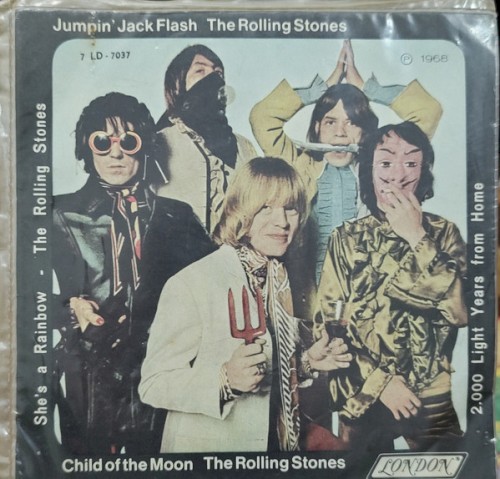
Sleeve art via the Cover Art Archive.
Metadata
| Title | Jumpin’ Jack Flash |
|---|---|
| Artist | The Rolling Stones |
| First released | 1968 |
| Written by | Mick Jagger, Keith Richards |
| Work | Jumpin’ Jack Flash |
| MusicBrainz recording | f542c6ec-ee1c-430c-88ed-195afc64ecc1 |
Lyrical themes
The song is narrated in the first person by someone recounting a childhood defined by hardship and privation — born in a storm, raised in poverty, subjected to cold and hunger and deprivation in ways that border on the nightmarish. The opening verses pile on images of a harsh, elemental upbringing: exposure to extreme weather, lack of shelter, cruelty. It reads almost like a litany of suffering.
Yet the emotional pivot is survival and defiance. Despite everything catalogued in those opening verses, the narrator declares himself unbroken — the refrain essentially announces that he is fine, that he has come through. The title phrase functions as a kind of celebratory identity, a self-naming that transforms the chaos of that upbringing into a source of energy rather than damage. The song moves from darkness to exuberance.
Keith Richards has spoken about the song drawing loosely on his own unconventional upbringing and his relationship with his gardener father, though the imagery is wildly exaggerated and mythologised rather than literally autobiographical. Mick Jagger has connected the spirit of the song to a feeling of liberation — emerging from a difficult period in the band's own history, including the legal troubles that had beset them in 1967.
The emotional register is ultimately triumphant and defiant, even raucous. There is no self-pity in the narrator's account of his rough start; the tone is boastful, almost gleeful. The suffering described is real within the song's world but it is worn as a badge rather than mourned. This combination — harrowing backstory, ecstatic present-tense pride — gives the lyric much of its peculiar charge, matching the song's explosive musical energy perfectly.
Song structure
Jumpin' Jack Flash runs as a lean, nearly riff-driven machine that never quite settles into a conventional verse-chorus architecture — instead it cycles relentlessly through what feels like a single, charged loop.
The song opens with one of rock's most immediately recognisable intros: a distorted, almost nasal acoustic guitar riff (achieved partly through open-tuned acoustic guitars recorded through a cassette player, giving it that buzzing, compressed texture). That riff is essentially the spine of the entire track, surfacing between and beneath every section.
From there the structure is roughly: intro riff — verse — pre-chorus build — chorus (the title-phrase hook, repeated with escalating force) — back to verse, and so on. There is no conventional bridge; the song relies on the cumulative weight of repetition rather than contrast. Each verse plants a chapter of vivid imagery before releasing into the chorus, which hits with a kind of joyful aggression.
The arrangement builds through dynamics rather than added instrumentation. The rhythm section — Charlie Watts's drums in particular — drives with a tight, almost martial snap. The guitars thicken and push forward as the song progresses. Keith Richards's riff never disappears; it anchors the song even when Jagger's vocal is at its most frenzied.
The outro holds the chorus hook in a kind of locked groove, repeating until the track fades. That fade feels less like an ending and more like the song continuing somewhere just beyond hearing.
The most memorable moment lands almost immediately — the opening riff is so distinctive that recognition is nearly instant. The second peak is the eruption into the first chorus, where everything that has been coiling tightly through the verse suddenly releases. The whole track clocks in at around three and a half minutes, tight and purposeful throughout.
Musical composition
Jumpin' Jack Flash is built around one of the most recognisable riffs in rock: a crunching, repetitive guitar figure that sits squarely in B major, though the recording famously sounds slightly sharp of concert pitch, giving it an almost physical edge that no clean, in-tune version quite replicates. The feel is a driving, medium-fast rock pulse — muscular and relentless rather than breathlessly fast — with a backbeat that locks in tight and never lets up.
The harmony is stripped nearly bare. The song rotates through a handful of chords anchored on the root, never straying far from home and never needing to. There are no jazz substitutions, no unexpected turns; the tension comes entirely from rhythm and repetition. This is blues thinking applied to hard rock: economy as a weapon.
The melody sits comfortably in a pentatonic shape, punchy and declarative. Jagger delivers it with a swagger that is more incantation than song — the melodic phrases are short, emphatic, and designed to be shouted back.
The production, handled by Jimmy Miller (his first major work with the Stones), is a watershed moment. Miller and the band deliberately sought a rawer, more abrasive sound than the psychedelic textures of Their Satanic Majesties Request. The guitars were reportedly recorded through acoustic guitar pickups to achieve a compressed, almost corroded bite. The mix is dense but focused: guitars piled on guitars, all crunch and no shimmer, with Bill Wyman's bass and Charlie Watts's drums locked together underneath. There are no strings, no orchestration, no studio trickery softening the blow. It sounds like a band playing in a room with all the air sucked out — which is precisely the point.
Historical context
By 1968, the Rolling Stones were navigating one of the most turbulent stretches of their early career. The psychedelic experiment of Their Satanic Majesties Request had left critics cold and the band creatively restless. Jumpin' Jack Flash arrived in May of that year as a deliberate course correction — a return to raw, riff-driven rock and roll that signalled the group rediscovering its identity.
The timing was charged. Student protests were erupting across Paris and campuses worldwide. Martin Luther King Jr. had been assassinated weeks before the single's release. The Beatles were preparing the White Album. Rock music was fragmenting in every direction, and the Stones responded not with studio experimentation but with something blunt and ferocious.
The song hit hard commercially. It reached number one in the United Kingdom and climbed to number three on the American Billboard Hot 100, becoming one of their strongest chart performances of the decade. Critics and fans alike recognized it as a resurgence, with many reviewers noting the return of the muscular guitar interplay that had defined the band's earlier work.
Recorded without the involvement of their longtime producer Andrew Loog Oldham, the single marked a new working dynamic for the group, with Jimmy Miller taking over production duties. That shift in the studio contributed noticeably to the tighter, harder sound.
The song functioned almost as a mission statement. After a period of drift, it established the template — bluesy structure, relentless momentum, Jagger's physical vocal delivery — that would carry the Stones through their celebrated run of late-sixties and early-seventies albums. It remains one of the clearest pivot points in their catalogue, the moment they stopped chasing a trend and started setting one again.
On screen
Jumpin' Jack Flash has enjoyed a long life on screen, partly through its own gritty swagger and partly through the high-profile cover recorded by Aretha Franklin for the 1986 Whoopi Goldberg comedy of the same name. That film — Jumpin' Jack Flash (1986), directed by Penny Marshall — built its entire identity around the song, using the Franklin version prominently and helping reintroduce the track to a new generation.
The Rolling Stones original has appeared in numerous other productions. It features in Good Morning, Vietnam (1987), Robin Williams's Vietnam-era radio comedy-drama, where it underscores the period atmosphere and the irreverent energy of the film's soundtrack. The song has also been used in Bohemian Rhapsody (2018), the Queen biopic, during concert and era-setting sequences.
On television, the track has surfaced regularly in shows evoking the late 1960s or deploying raw rock energy for dramatic effect. It appeared in episodes of The Simpsons as a cultural touchstone, and various sports broadcasts and promotional packages have licensed it for its punchy opening riff and immediate sense of momentum.
In advertising, its distinctive opening figure has made it attractive to brands seeking to borrow that classic rock credibility, though specific campaigns are harder to pin down with certainty across decades of use.
The song's most cinematically significant moment may still be the Aretha Franklin recording commissioned directly for Whoopi Goldberg's film — a rare case of a cover version effectively becoming a title theme and giving the original a second commercial life simultaneously. The Stones track and the Franklin cover have since circulated together in popular memory, each reinforcing the other's visibility on screen.
Covers & hits
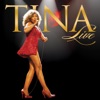
'Jumpin' Jack Flash' has proven one of rock's most durable riff-driven anthems, a song that leapt from a 1968 chart-topping single into a standard covered across genres for decades. Its rolling, distorted guitar figure and raw energy attracted artists ranging from blues veterans to pop stars, and it gained a fresh wave of attention when it anchored a 1986 comedy film of the same name, bringing in a high-profile soul-inflected remake that introduced the song to a new generation.
Previews and buy links via the iTunes Search API; other links open a search on that service.
Influence & legacy
"Jumpin' Jack Flash" landed in 1968 as a kind of reset for the Rolling Stones — leaner and harder than their psychedelic experiments — and the rock world took notice immediately. Its open-tuned riff and survival-against-the-odds swagger set a template that subsequent generations of rock and roll acts kept returning to.
The song's most prominent second life came through Aretha Franklin, whose 1986 recording for the film of the same name brought it to a new generation and demonstrated how naturally the song's defiant energy translated across genres. That version was produced by Keith Richards himself, cementing the song's cross-generational reach.
Notable samples and interpolations have spread across hip-hop and R&B, though the song's DNA shows up more often as a vibe and a structural reference point than in direct sampling — its riff is simply too recognizable to lift without comment.
Canonically, the song sits near the top of almost every serious ranking of rock recordings. Rolling Stone magazine has placed it among the greatest songs ever made. It appears on multiple authoritative lists of the best singles of the 1960s and of rock history overall.
In live performance the song has been a Stones set-list constant for more than five decades, which itself speaks to its durability — audiences who were not born when it was released respond to it as if it were elemental. Guitar instructors use its open-G tuning as a teaching text for Keith Richards's whole approach to the instrument.
Today it occupies the rare position of being simultaneously a musicologist's reference point, a crowd-rousing concert staple, and a song that still sounds genuinely urgent — not preserved in amber but alive on its own terms.