Song dossier
Hey Jude
✓ Verified against MusicBrainz Analysis by AI — lyrics discussed, never reproduced
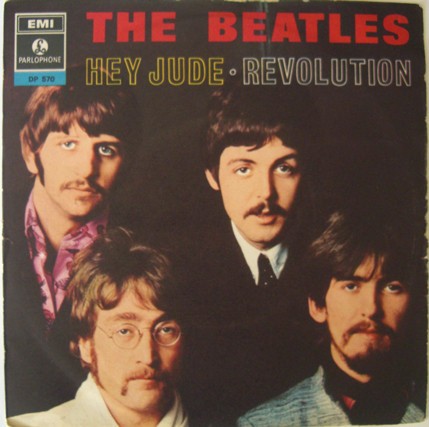
Sleeve art via the Cover Art Archive.
Metadata
| Title | Hey Jude |
|---|---|
| Artist | The Beatles |
| First released | 1968-08-26 |
| Written by | John Lennon, Paul McCartney |
| Length | 7:18 |
| Work | Hey Jude |
| MusicBrainz recording | 7b0b9016-59c5-4a83-9bcc-a6051453e422 |
Lyrical themes
At its core, "Hey Jude" is a song of encouragement — one person urging another not to retreat into sadness but to open themselves up to love and possibility. The narrator addresses someone who seems hesitant, afraid of vulnerability, perhaps inclined to shoulder pain alone rather than let another person in. The message is persistent but gentle: stop holding back, take the emotional risk, allow something good to happen.
Paul McCartney wrote the song with John Lennon's young son Julian in mind. Julian's parents had recently separated, and McCartney, driving out to visit him, began composing words of comfort on the way. The "Jude" of the title is Julian, softened into a more singable name. That origin gives the lyric a specific tenderness — it is an adult reaching toward a child navigating adult-sized pain, though the words are universal enough to speak to anyone nursing a private hurt.
The emotional arc moves from reassurance into release. Early verses are intimate and coaxing, but the song builds toward a collective, almost ecstatic resolution. The famous extended coda — the long, repeated refrain that carries the song past the four-minute mark and on toward seven — transforms a private conversation into something communal and celebratory. What begins as a whisper becomes a shout shared by a crowd.
The imagery throughout favors the body and the heart over the abstract: shoulders, skin, movement, the act of letting someone in. There is warmth rather than poetry in the conventional sense — the language is plain, even conversational, which makes its emotional directness hit harder. McCartney later said Lennon heard the song as addressed partly to himself, and that interpretation holds. The encouragement is both outward and inward, a reminder to the giver as much as the receiver.
Song structure
Hey Jude opens with a bare piano and McCartney's voice alone — almost startlingly intimate given what comes later. That stripped introduction lasts just long enough to draw the listener in before a restrained rhythm section joins for the first verse, keeping the texture light and conversational.
The song follows a verse-verse-bridge-verse pattern that cycles twice before it commits to its famous final section. The verses carry the emotional arc — each one building fractionally in density as Lennon's acoustic guitar and then subtle strings begin to fill the background. The bridge offers a brief change of perspective and harmonic colour, acting as a moment of reassurance before the verses resume.
By the third verse cycle, the full orchestra has arrived. The arrangement swells steadily without announcing itself dramatically — the strings and brass accumulate rather than burst in. The emotional peak of the composed section lands here, just before the song pivots entirely.
What follows is the extended coda — the repeated "na na na" refrain that runs for roughly four minutes, making the song's total length about seven minutes and eleven seconds, unusually long for a 1968 single. That coda begins with the full band and ensemble locking into a gospel-influenced groove, and it builds through layered vocal improvisations from McCartney. Additional voices (reportedly including studio personnel recruited for the session) join progressively, creating the effect of a crowd gathered around a communal moment.
The memorable structural payoff is precisely that transition: the careful, almost tender composed song giving way to something ecstatic and communal. The quiet opening and the joyful noise of the closing coda form a dramatic arc across the song's full length, making the journey from solitude to celebration the real structural statement.
Musical composition
Hey Jude sits in F major throughout, a warm, open key that suits Paul McCartney's broad, expressive vocal style. There are no dramatic modulations — the song stays rooted in its home key from start to finish, which gives it an unusual sense of stability and inevitability.
The tempo is unhurried, a gentle mid-pace that feels more like a slow walk than a ballad. The feel is gospel-inflected rock, building steadily from an intimate opening to a full communal celebration.
Harmonically the song is straightforward, leaning on the three primary chords — the tonic, the subdominant, and the dominant — with very little deviation. What sounds rich comes less from harmonic complexity than from voicing, dynamics, and the sheer scale of sound accumulated by the end.
The melody opens with a falling, conversational phrase that sits comfortably in the middle of the voice, making it feel personal and unguarded. McCartney uses a wide range by the song's climax, stretching into an almost gospel cry that feels earned rather than showy. The repeated melodic refrain of the long outro locks in like a chant, designed to be sung along with.
The recording was produced by George Martin and engineered at Trident Studios in London in 1968. Martin brought in a thirty-six-piece orchestra, whose entrance roughly halfway through transforms the texture entirely. The record has a layered, cumulative character: it begins with just McCartney's voice and piano, adds drums, bass, and electric guitar by stages, then arrives at that massive orchestral and choral wall for the extended fade-out, which runs over four minutes — extraordinarily long for a pop single at the time. The piano sound is upfront and slightly dry, the bass full and melodic.
Historical context
By the summer of 1968, the Beatles were navigating one of the most turbulent periods of their existence. Brian Epstein, their manager, had died the previous year. The band had retreated from touring and was beginning to fracture internally, with tensions over the Apple Corps venture and the recording sessions that would eventually produce the White Album. "Hey Jude" arrived in this atmosphere as something of a public statement of resilience.
Paul McCartney wrote the song as a gesture of comfort toward John Lennon's son Julian during his parents' divorce, though it quickly took on a broader emotional resonance. Released in August 1968 as the debut single on the Beatles' own Apple Records label, it carried extra significance as the commercial launch of that venture.
The single became a phenomenon almost immediately. It topped charts across multiple countries, reaching number one in the United States, the United Kingdom, and many other markets. Its reign at the top of the American charts lasted for an exceptionally long stretch, making it one of the biggest-selling singles of the era. At over seven minutes, it was strikingly long by the radio standards of the time, yet broadcasters played it in full regardless.
Culturally, 1968 was one of the most convulsive years of the twentieth century — assassinations, the Vietnam War, uprisings in Paris and Chicago. The song's message of encouragement and its extended, communal outro gave it an anthemic quality that felt almost deliberately counter to the surrounding chaos. Critics and audiences received it warmly, and it helped demonstrate that the Beatles, despite their internal struggles, remained the dominant creative force in popular music. It stands as the best-selling single of their career.
On screen
"Hey Jude" has enjoyed a remarkably durable screen life, partly because its slow build and communal sing-along finale make it easy to attach to moments of emotional release or uplift.
One of its most celebrated uses came in the 2009 animated feature "Coraline," directed by Henry Selick, where a version of the song plays during end credits — though the most firmly documented theatrical moment is its use in the 2005 film "Fever Pitch," the American romantic comedy starring Drew Barrymore and Jimmy Fallon, where the song underscores a climactic scene tied to joy and reconciliation.
The song also appears in the 2007 Beatles-themed musical film "Across the Universe," directed by Julie Taymor, which built its entire narrative around Beatles songs performed as covers — "Hey Jude" features among them in an emotionally charged sequence.
In advertising, the track has been licensed for television commercials on multiple occasions, most notably for car manufacturers seeking that combination of warmth and scale the song's final movement provides.
British television and documentary contexts have drawn on it repeatedly, particularly for retrospectives on the 1960s or on the Beatles themselves, including various BBC programmes marking anniversaries of the recording.
Perhaps the most widely seen screen context, however, is the original 1968 promotional film the Beatles made for the song — effectively an early music video — in which the band performs surrounded by hundreds of invited members of the public who join in the coda. This film has been broadcast countless times across decades of television programming and is now viewable on streaming platforms, meaning it remains one of the defining screen images associated with the song.
Covers & hits
Few songs have traveled as far from their origins as 'Hey Jude.' Written by Paul McCartney to comfort John Lennon's son Julian during his parents' divorce, it became The Beatles' best-selling single and one of the best-selling singles of all time. Its expansive structure and anthemic coda have made it irresistible to cover artists across genres, from soul singers to classical crossover acts, cementing its place as one of the most recorded songs in pop history.

Previews and buy links via the iTunes Search API; other links open a search on that service.
Influence & legacy
Few pop songs have cast as long a shadow. "Hey Jude" became the best-selling single of 1968 in both the UK and the US, and it remains one of the best-selling singles in history. Its slow build toward a communal, repeated coda helped establish a template for the epic pop finale that countless producers and artists would borrow in the decades that followed.
The song's influence on subsequent recording culture is hard to overstate. Its willingness to let a single extended sequence — the repeated refrain — run for roughly four minutes demonstrated that mainstream audiences would accept unconventional song structures when the emotional payoff was strong enough. That lesson reverberated through arena rock, soul, and eventually stadium pop.
In terms of canonical standing, the song regularly places among the greatest singles ever made. Rolling Stone has consistently ranked it among the top handful of songs in its lists of the greatest recordings of all time, and it appears on virtually every reputable critics' survey of the rock era's landmarks.
Numerous artists have covered it, from soul and gospel interpretations to orchestral arrangements, though none has displaced the original in the popular imagination. It has been interpolated and sampled across genres, though the more important lineage is structural and emotional rather than sample-based — producers studying how to build a record toward a euphoric group singalong frequently cite it.
The song retains a strong live presence. Paul McCartney closes concerts with it reliably, and audiences across generations join the coda in real time, demonstrating that its communal design still functions exactly as intended. More than fifty years on, it is treated less as a period artifact than as a permanent piece of shared cultural furniture.